A jackknife truck accident can happen in seconds, but the aftermath often lasts much longer. If you have witnessed one of these crashes, or been involved in one, you may be wondering how a massive tractor-trailer suddenly folded in on itself and lost control. Understanding the causes behind a jackknife truck accident is often the first step toward making sense of what happened.
These crashes are not random. They typically result from a combination of driver behavior, road conditions, vehicle maintenance, and cargo loading practices. Because a jackknifing trailer can swing across multiple lanes of traffic, the consequences for nearby drivers can be severe.
This article explains what causes jackknife truck accidents, who may be responsible, and what steps people typically take after one occurs. It is intended to help you understand the topic generally, not to serve as legal advice for your specific situation.
Quick Answer
A jackknife truck accident happens when a tractor-trailer’s rear trailer swings outward and folds toward the cab, usually because the trailer or tractor loses traction. The most common causes are sudden or hard braking, excessive speed for road conditions, wet or icy pavement, worn brakes or tires, and unevenly loaded or shifting cargo. Because the trailer can swing across multiple lanes, jackknife crashes often cause serious multi-vehicle collisions.
Quick Summary
- Jackknife accidents happen when a tractor-trailer’s trailer swings out and folds toward the cab, usually after the trailer or tractor loses traction.
- Common causes include sudden or hard braking, excessive speed, wet or icy roads, mechanical defects, and improperly loaded or shifting cargo.
- These crashes can block multiple lanes and often lead to serious multi-vehicle collisions.
- Liability can fall on the truck driver, the trucking company, a cargo loading company, or a maintenance provider, depending on what caused the crash.
- Evidence such as driver logs, maintenance records, and weather data often plays a major role in determining fault.
- Laws and procedures vary by state, so speaking with a qualified attorney is the best way to understand options after a jackknife crash.
What Is a Jackknife Truck Accident?
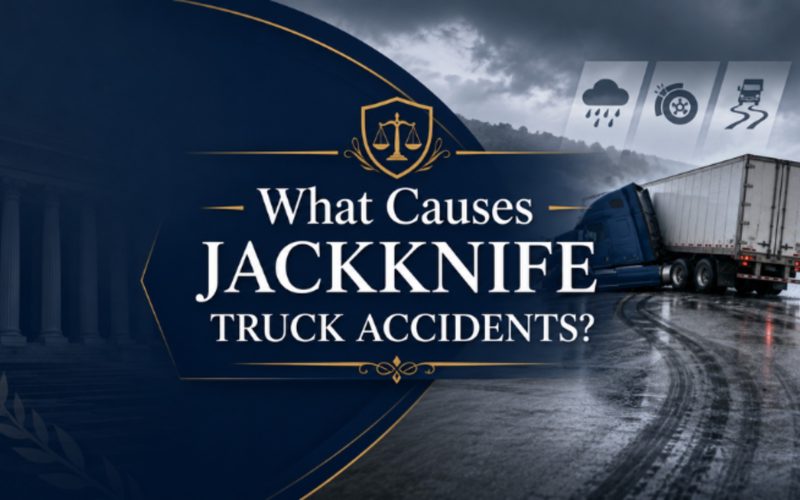
A jackknife truck accident occurs when a tractor-trailer’s trailer swings outward and folds toward the cab at a sharp angle, forming a shape similar to a folding pocketknife. This happens when either the tractor or the trailer loses traction with the road while the other part continues moving, causing the two sections to fold at the pivot point that connects them.
There are two general types of jackknife events:
- Tractor jackknife: The cab loses traction first, often after sudden braking or hitting a slick surface, and skids sideways while the trailer continues forward.
- Trailer jackknife: The trailer loses traction first and swings outward, forcing the cab to follow or lose control.
Because jackknifing is unique to vehicles with a tractor and trailer connected by a pivot point, it does not occur in standard passenger vehicle crashes.
Who Is Affected by Jackknife Truck Accidents?
Jackknife accidents put everyone nearby at risk, not just the truck driver. Because a jackknifing trailer can swing across two or more lanes, it may strike several vehicles or block traffic without warning. Similar dangers can arise when a commercial vehicle overturns, often due to the common causes of rollover truck accidents. The people most commonly affected include:
- Drivers and passengers in nearby vehicles who may be struck by the swinging trailer
- The truck driver, who may lose control entirely or suffer injuries from the cab spinning or rolling over
- Pedestrians or cyclists in the path of the skid, in rare cases on city streets or near loading areas
- Other motorists involved in secondary collisions caused by sudden lane blockages
Commercial trucks can weigh up to 80,000 pounds when fully loaded, which is significantly heavier than a typical passenger vehicle. This weight difference is a major reason jackknife crashes tend to cause severe injuries.
Common Causes of Jackknife Truck Accidents
Jackknife accidents rarely have a single cause. They usually result from a combination of driver actions, road conditions, equipment problems, or cargo issues working together. The table below summarizes the most frequently cited causes.
| Cause | How It Leads to a Jackknife |
| Sudden or hard braking | Locks the wheels on the cab or trailer, causing one part to skid out of alignment with the other, especially when braking on a downgrade or during a turn. |
| Excessive speed for conditions | Reduces the time and traction margin a driver has to slow down gradually, increasing the force of any skid on curves, wet roads, or downhill grades. |
| Wet, icy, or slippery roads | Lowers traction between the tires and the road, making it easier for the trailer to swing out once braking or steering input is applied. |
| Worn or defective brakes | Uneven braking power between the tractor and trailer can cause one unit to stop faster than the other, triggering a jackknife. |
| Bald or underinflated tires | Reduces grip on the road surface, particularly in wet or icy conditions, making the trailer more likely to lose traction. |
| Improperly loaded or shifting cargo | Uneven or unsecured freight changes the trailer’s center of gravity, making the rig harder to control during turns, lane changes, or braking. |
| Driver fatigue or inattention | Slows reaction time and can lead to last-second hard braking or overcorrection, both of which can trigger a jackknife. |
| Inexperience with the route or conditions | Drivers unfamiliar with steep grades, sharp curves, or local weather may not adjust speed or braking technique in time. |
Sudden or Improper Braking
Hard braking is one of the most commonly cited triggers for a jackknife accident. When a driver brakes suddenly or too forcefully, especially while turning, going downhill, or on a slippery surface, the wheels on the cab or trailer can lock and skid. This is more likely when the truck’s braking system distributes force unevenly between the tractor and trailer.
Excessive Speed for Road Conditions
Driving too fast for the weather, traffic, or road layout reduces a driver’s margin for error. A truck traveling too quickly into a curve, downhill grade, or wet roadway has less time to slow down gradually, which increases the chance that braking will trigger a skid rather than a controlled stop.
Adverse Weather and Slippery Roads
Rain, snow, ice, and even spilled cargo on the roadway can dramatically reduce traction. When a trailer’s tires lose grip, even modest braking or steering adjustments can cause the trailer to swing out from behind the cab.
Mechanical Defects
Worn or poorly maintained brakes are a frequent factor in jackknife crashes, particularly when braking power is uneven between the tractor and trailer. Bald or underinflated tires can also reduce traction, especially in wet or icy conditions. Regular inspections and maintenance are intended to catch these issues before they cause a loss of control.
Improperly Loaded or Shifting Cargo
How cargo is loaded can directly affect a trailer’s stability. Weight concentrated too far forward can make brakes overly sensitive, while too much weight toward the rear can lighten the front wheels and reduce steering control. Unsecured freight that shifts suddenly during a turn or lane change can throw off the trailer’s center of gravity and contribute to a jackknife.
Driver Fatigue, Distraction, or Inexperience
Federal hours-of-service rules limit how long commercial drivers may drive without rest, generally allowing up to 11 hours of driving within a 14-hour on-duty window after 10 consecutive hours off duty. These limits are designed to reduce fatigue-related crashes, but violations still occur. A fatigued, distracted, or inexperienced driver may react late to changing conditions, often resulting in last-second hard braking that can trigger a jackknife.
Legal Process and Potential Liability
Because jackknife accidents often involve multiple contributing factors, more than one party may share responsibility. Identifying every liable party is an important part of evaluating damages and calculating a personal injury settlement. Investigators and attorneys typically look at several potential sources of liability, including:
- The truck driver, if speeding, fatigue, distraction, or reckless braking contributed to the crash
- The trucking company, for inadequate driver training, pressuring drivers to meet unsafe schedules, or failing to maintain its fleet
- A cargo loading company, if improperly secured or imbalanced freight contributed to the loss of control
- A maintenance provider, if poor servicing led to brake or tire failure
- A parts or vehicle manufacturer, in cases involving a defective braking or coupling component
Liability rules and the process for pursuing a claim vary significantly by state. Some states follow comparative fault rules that can reduce compensation based on a person’s own percentage of fault, while others use different standards. An attorney licensed in your state can explain how these rules may apply to a specific situation.
Evidence Commonly Used to Determine Fault
Determining what caused a jackknife accident usually requires a detailed investigation. The following types of evidence are commonly reviewed:
| Evidence Type | Why It Matters |
| Police crash report | Provides an official record of how the crash occurred, road conditions, and citations issued. |
| Electronic logging device (ELD) data | Shows the driver’s hours of service and whether federal driving-time limits were followed. |
| Truck maintenance records | Indicates whether brakes, tires, and coupling systems were properly inspected and serviced. |
| Cargo loading and weight documents | Helps show whether freight was loaded and secured according to standard practice. |
| Weather and road condition reports | Establishes whether conditions like ice, rain, or construction contributed to the crash. |
| Photos and video from the scene | Captures the trailer’s position, skid marks, and surrounding damage before evidence is cleared away. |
| Witness statements | Can confirm details such as speed, braking, or erratic movement leading up to the crash. |
Timelines to Keep in Mind
Every state sets its own filing deadline, known as a statute of limitations, for pursuing a personal injury or property damage claim after a truck accident. These deadlines vary widely depending on the state and the type of claim involved. Missing a filing deadline can prevent a claim from moving forward at all, so it is important to confirm the applicable deadline with an attorney or your state’s court system as soon as possible after a crash.
Mistakes to Avoid After a Jackknife Truck Accident
- Leaving the scene before law enforcement arrives or before exchanging information, where required by state law
- Failing to seek medical attention, even when injuries are not immediately obvious
- Giving a detailed statement to an insurance adjuster before understanding your rights
- Waiting too long to document the scene, since skid marks and cargo positioning can change quickly
- Assuming the truck driver is automatically at fault without reviewing maintenance, loading, and company records
When to Speak With an Attorney
Jackknife truck accident cases often involve federal trucking regulations, multiple potentially liable parties, and significant injuries. Speaking with a qualified attorney can help you understand applicable deadlines, your state’s liability rules, and what evidence may need to be preserved. Many personal injury attorneys offer free initial consultations, and you are generally not required to make any decisions during that first conversation.
Practical Next Steps
- Seek medical evaluation, even if you feel only minor discomfort after the crash
- Request a copy of the official police crash report once it becomes available
- Photograph the scene, vehicle positions, and any visible cargo or road conditions, if safe to do so
- Keep records of medical visits, missed work, and related expenses
- Avoid signing settlement documents from an insurance company before understanding your options
- Contact a licensed attorney in your state to discuss your specific situation
Understanding What Causes Jackknife Truck Accidents Helps You Take the Right Next Step
A jackknife truck accident usually results from a mix of factors, including sudden braking, excessive speed, poor weather, mechanical defects, and improperly loaded cargo. Because these crashes can affect multiple vehicles at once, the aftermath is often complicated, involving more than one potentially responsible party and state-specific rules about fault and filing deadlines.
If you have questions about a jackknife truck accident you witnessed or were involved in, the most reliable next step is to speak with a qualified attorney in your state or contact the appropriate government agency. They can review the specific facts of your situation and explain the options that may be available to you.
Take the first step toward understanding your legal situation. Visit US Legal Journal for clear information about your rights, options, and possible next actions.
Frequently Asked Questions
Do all jackknife accidents involve a collision with another vehicle?
No. A truck can jackknife without striking another vehicle, particularly on an empty roadway or shoulder. However, because the trailer can swing across multiple lanes, collisions with nearby vehicles are common, especially in heavy traffic.
Is there a deadline for filing a claim after a jackknife truck accident?
Yes, every state sets its own filing deadline, called a statute of limitations, and these vary by state and by the type of claim. Confirm the deadline that applies to your situation with an attorney or your state’s court system as soon as possible.
Can a trucking company be held responsible even if the driver caused the crash?
In some cases, yes. Trucking companies can face liability for issues like inadequate training, pressuring drivers to violate hours-of-service rules, or failing to maintain their vehicles, depending on the facts and applicable state law.
What should I do if I witness a jackknife accident but am not involved?
If it is safe to do so, you can contact emergency services and provide a statement to law enforcement. Witness accounts of speed, weather, or vehicle behavior before the crash can be valuable to an investigation.
Does insurance automatically cover damages from a jackknife accident?
Commercial trucking companies are generally required to carry insurance, but coverage and the claims process vary by policy, state, and the specifics of the crash. Reviewing the situation with an attorney can clarify what coverage may apply.
People Also Ask
What is the most common cause of a jackknife truck accident?
Sudden or improper braking is one of the most frequently cited causes. When a driver brakes hard, especially while turning, on a downgrade, or on a slippery surface, the trailer or cab can lock up and skid out of alignment, triggering a jackknife.
Can bad weather cause a truck to jackknife?
Yes. Rain, snow, and ice reduce traction between the tires and the road. Even normal braking or steering can cause a trailer to lose grip and swing outward on a wet or icy surface, especially if the driver does not adjust speed for the conditions.
Who is liable for a jackknife truck accident?
Liability depends on what caused the crash. It may fall on the truck driver, the trucking company, a cargo loading company, or a maintenance provider. An investigation into driver logs, maintenance records, and cargo documentation usually helps determine fault.
Are jackknife accidents always the truck driver’s fault?
Not necessarily. While driver error is a common factor, mechanical defects, poor vehicle maintenance, or improperly loaded cargo by another party can also cause or contribute to a jackknife accident, which may shift liability away from the driver alone.
How dangerous are jackknife truck accidents?
Jackknife accidents are considered among the more dangerous types of commercial truck crashes because the trailer can swing across multiple lanes of traffic, often leading to multi-vehicle collisions and serious injuries.
This article is for general informational purposes only and does not provide legal advice. Laws and procedures may vary by state, city, court, agency, or individual situation. For advice about your specific legal issue, speak with a qualified attorney or the appropriate government agency.