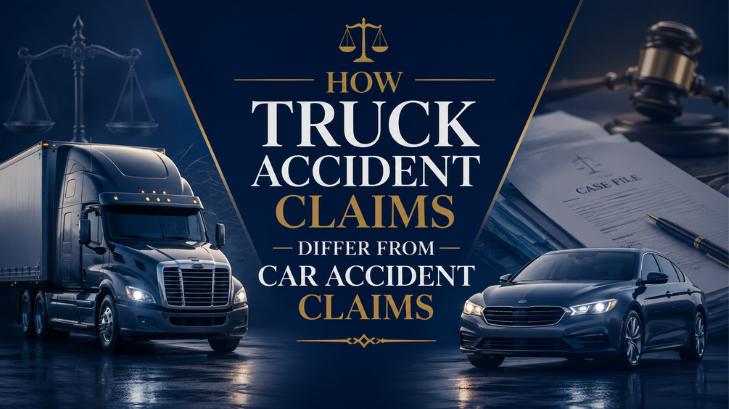
If you were just hit by a commercial truck, you may be wondering why your claim feels so different from a typical fender-bender. It is not your imagination. A truck accident vs car accident claim involves different insurance rules, different evidence, and often more than one company on the other side.
Car accident claims usually involve two drivers, two personal auto policies, and state traffic law. Truck accident claims add federal safety regulations, commercial insurance policies with much higher limits, and potential liability for the trucking company itself, not just the driver.
This guide breaks down the truck accident claim process, how it differs from a standard car accident claim, and what documents, deadlines, and decisions typically come up along the way. It is written for general education, not as legal advice for your specific situation.
Quick Answer
A truck accident claim differs from a car accident claim mainly because trucking companies are regulated by the Federal Motor Carrier Safety Administration (FMCSA), carry much higher minimum insurance coverage (often $750,000 or more, versus state-minimum auto coverage), and can involve multiple potentially liable parties — the driver, the trucking company, a cargo loader, or a maintenance provider. Truck claims typically require more evidence, take longer to resolve, and involve larger insurance companies with dedicated legal teams. Because the legal and procedural details vary by state and by case, anyone involved in a serious truck accident should speak with a qualified attorney before accepting any settlement.
Quick Summary
- Truck accident claims involve federal regulations (FMCSA rules) that do not apply to ordinary car accident claims.
- Commercial trucking companies generally must carry significantly higher insurance limits than passenger vehicle drivers, though exact requirements depend on the type of carrier and cargo.
- A truck accident may involve several potentially responsible parties — not just the driver — including the trucking company, a maintenance contractor, or a cargo loading company.
- Evidence in truck claims often includes electronic logging device (ELD) data, driver logs, and maintenance records, which generally do not exist in car-only accidents.
- Filing deadlines (statutes of limitations) vary by state for both truck and car accident claims, so timing matters.
- Because truck claims are more complex and often involve aggressive insurance defense, many people consult an attorney earlier than they might for a routine car accident.
What Counts as a Truck Accident Claim vs. a Car Accident Claim?
A car accident claim typically arises when two or more passenger vehicles collide, and the claim is handled under each driver’s personal auto insurance policy and the state’s traffic and tort laws.
A truck accident claim usually involves a commercial motor vehicle — such as a tractor-trailer, box truck, delivery truck, or other large commercial vehicle used for business purposes. Because the truck is operated as part of a business, the claim can extend beyond the driver to the company that owns or operates the truck.
This is the core of the truck accident vs car accident claim distinction: one is generally a dispute between two individuals and their insurers, while the other can involve a commercial entity, federal safety rules, and a layered insurance structure.
Who Is Affected by These Differences?
These differences matter most to:
- Drivers, passengers, cyclists, or pedestrians injured in a crash involving a commercial truck, tractor-trailer, delivery vehicle, or bus.
- Family members pursuing a claim on behalf of someone seriously injured or killed in a truck collision.
- Anyone trying to understand why a truck-related claim is taking longer, or involves more paperwork, than a typical car accident claim.
- Small business owners or commercial drivers who may be named as a defendant or contacted by an insurer after a crash.
Key Legal and Practical Differences
1. Regulatory Framework: Federal Rules vs. State Traffic Law
Car accidents are governed primarily by state traffic laws and each state’s negligence or comparative fault rules. Truck accidents add a layer of federal oversight, especially when violations involve driver conduct, vehicle maintenance, or cargo handling. Understanding what causes jackknife truck accidents can also help explain why federal trucking rules play such an important role in preventing serious crashes. The Federal Motor Carrier Safety Administration (FMCSA), part of the U.S. Department of Transportation, sets safety rules for interstate commercial trucking under Title 49 of the Code of Federal Regulations.
Common FMCSA-related rules that can come up in a truck accident claim include:
- Hours-of-service (HOS) limits, which restrict how long a driver may drive before resting, to reduce fatigue-related crashes.
- Driver qualification requirements, including a valid commercial driver’s license (CDL) and required medical certification.
- Vehicle inspection and maintenance recordkeeping requirements.
- Cargo securement rules intended to prevent shifting or spilled loads.
- Drug and alcohol testing requirements for commercial drivers.
A documented violation of an FMCSA rule does not automatically decide a case, but it can be relevant evidence of negligence depending on the facts and the state’s law. Whether and how a regulatory violation affects a specific claim is a legal question that depends on your state and the details of the crash.
2. Insurance Coverage and Policy Limits
Passenger vehicle drivers are generally required to carry the minimum auto liability insurance set by their state, which varies widely from state to state and is often a relatively modest amount.
Commercial trucking companies operating in interstate commerce are subject to federal minimum financial responsibility requirements under 49 CFR Part 387. For most for-hire carriers transporting non-hazardous freight in vehicles over 10,001 pounds, the federal minimum is generally $750,000 in public liability coverage. Carriers transporting certain hazardous materials may be required to carry $1 million to $5 million in coverage, depending on the cargo. Many carriers also carry additional excess or umbrella coverage beyond these federal minimums.
This is one reason truck accident claims often involve more insurance company involvement: there may be a primary commercial policy, an excess policy, and separate coverage for the trucking company versus an owner-operator or independent contractor driver.
3. Who Can Be Held Responsible (Liability)
In a typical car accident, liability usually falls on one or both drivers. In a truck accident, the list of potentially responsible parties can be longer, depending on what caused the crash:
- The truck driver, for negligent driving, fatigue, distraction, or an hours-of-service violation.
- The trucking company (motor carrier), which may be responsible for the driver’s actions under the legal doctrine that holds employers responsible for employees acting within the scope of their job, or for its own negligence in hiring, training, or supervision.
- A maintenance contractor, if poor upkeep (such as brake failure) contributed to the crash.
- A cargo loading company, if improperly loaded or secured freight caused the truck to become unstable.
- A parts manufacturer, in rare cases involving a defective vehicle component.
Identifying every potentially responsible party generally requires investigation beyond the police report — something that is less commonly necessary in a routine two-car accident.
4. Evidence and Documentation Needed
Both types of claims typically rely on police reports, photos, medical records, and witness statements. Truck accident claims often require additional categories of evidence that do not exist in ordinary car accident cases:
- Electronic logging device (ELD) data showing the truck’s speed, braking, and the driver’s hours.
- Driver qualification files and CDL records.
- Vehicle inspection, maintenance, and repair records.
- Dispatch records and communication logs between the driver and the trucking company.
- Black box or event data recorder (EDR) information.
Some of this data is only required to be retained for a limited time, which is why prompt action and, where appropriate, an early evidence-preservation request can matter in truck cases.
5. Injury Severity and Claim Value
Because of the size and weight difference between commercial trucks and passenger vehicles, truck collisions are more likely to result in severe injuries. A fully loaded commercial truck can weigh many times more than a passenger car, and the resulting forces in a collision are often far greater than in a typical car-to-car crash.
This severity is one reason truck accident claims, on average, tend to involve larger damages than typical car accident claims — though the actual value of any claim depends entirely on the specific facts, injuries, and applicable law, and no outcome or amount can be guaranteed.
6. Timeline and Complexity of the Claims Process
Car accident claims with clear liability and moderate damages can sometimes resolve in a few months. Truck accident claims generally take longer because they may involve:
- Multiple insurance carriers and defendants, each with their own legal representation.
- A more extensive investigation, sometimes including accident reconstruction experts.
- Review of federal compliance records and electronic data.
- More resistance from well-resourced commercial insurers before reaching a resolution.
The Truck Accident Claim Process: Step by Step
While exact procedures vary by state, a truck accident claim process generally follows a similar sequence to other personal injury claims, with some additional steps:
- Seek medical attention and call law enforcement to the scene, even if injuries seem minor.
- Document the scene: photos of the vehicles, the road, skid marks, cargo, and visible damage.
- Identify all parties involved, including the trucking company name, not just the driver’s information.
- Obtain the police accident report once available.
- Preserve evidence quickly, since electronic logs and some records may only be retained for a limited period.
- Notify insurance companies, while being cautious about giving detailed statements before understanding your rights.
- Track medical treatment and expenses related to the crash.
- Consult a qualified attorney, particularly given the number of parties and insurers often involved in truck claims.
- File the claim or lawsuit within your state’s statute of limitations.
Common Mistakes to Avoid
- Assuming a truck accident claim works just like a car accident claim, only larger — the legal framework is genuinely different.
- Giving a recorded statement to the trucking company’s insurer before understanding how it may be used.
- Waiting too long to act, which risks losing access to electronic logs, maintenance records, or other time-limited evidence.
- Accepting an early settlement offer before the full extent of injuries and damages is known.
- Overlooking potentially liable parties beyond the driver, such as the trucking company or a maintenance provider.
- Not confirming filing deadlines, which vary by state and can bar a claim entirely if missed.
State and Location Notes
Because most personal injury law in the United States is governed at the state level, important details — including the statute of limitations, comparative or contributory fault rules, and how police reports are obtained — vary from state to state. Federal trucking regulations apply nationwide to interstate carriers, but they work alongside, not instead of, your state’s traffic and injury laws.
If your accident occurred on a major interstate freight corridor or in a state with a large volume of commercial trucking traffic, the claim may still follow your state’s procedural rules even though FMCSA regulations apply to the truck and carrier. Always confirm state-specific deadlines and procedures with a licensed attorney in your state or with your state’s court or bar association resources.
When to Speak With a Lawyer
Not every accident requires a lawyer, but truck accident claims are more likely to benefit from early legal guidance because of the number of parties, the higher insurance limits involved, and the technical evidence at stake. It may be worth speaking with an attorney if:
- The crash involved a commercial truck, tractor-trailer, or other large commercial vehicle.
- You suffered a serious injury, hospitalization, or long-term medical treatment.
- Liability is disputed, or more than one party may share fault.
- An insurance company has already contacted you for a statement or settlement offer.
- You are unsure about your state’s filing deadline.
Practical Next Steps
- Gather and organize all documentation: police report, photos, medical records, and any correspondence with insurers.
- Avoid posting about the accident on social media while a claim is pending.
- Keep a written timeline of symptoms, treatment, and missed work.
- Ask any attorney you consult about their experience specifically with truck or commercial vehicle claims, not just general car accident cases.
- Confirm your state’s statute of limitations as early as possible.
Truck Accident Claim vs. Car Accident Claim: Side-by-Side Comparison
| Factor | Car Accident Claim | Truck Accident Claim |
|---|---|---|
| Governing rules | State traffic and tort law | State law plus federal FMCSA regulations (49 CFR) |
| Typical insurance minimums | State-mandated minimum auto liability coverage | Often $750,000+ under federal minimums; can reach $1M–$5M for hazmat carriers |
| Potentially liable parties | Usually one or both drivers | Driver, trucking company, maintenance provider, cargo loader, or manufacturer |
| Key evidence | Police report, photos, witness statements | Adds ELD/black box data, driver logs, maintenance and inspection records |
| Typical injury severity | Ranges from minor to severe | Often more severe due to size and weight differences |
| Claims process length | Can resolve in weeks to months | Often takes longer due to multiple parties and insurers |
Understanding a Truck Accident Claim vs. Car Accident Claim Before You Take the Next Step
A truck accident vs car accident claim is not simply a bigger version of the same process. Federal trucking regulations, higher insurance limits, multiple potentially responsible parties, and specialized evidence make truck claims meaningfully different from standard car accident cases, often requiring more time, documentation, and careful handling.
If you were involved in a crash with a commercial truck, understanding these differences can help you ask better questions and avoid common pitfalls, such as giving a hasty statement or missing a filing deadline. Because the truck accident claim process and applicable deadlines vary by state, the most reliable next step is to review your accident details with a qualified attorney licensed in your state or to contact your state’s relevant consumer protection or insurance agency for guidance specific to your situation.
Frequently Asked Questions
How long do I have to file a truck accident claim?
Filing deadlines, known as statutes of limitations, vary by state and can also depend on whether the claim is for injury, property damage, or wrongful death. Check your state’s specific deadline or ask a licensed attorney, since missing the deadline can bar your claim entirely.
What if I was partly at fault for the truck accident?
Many states allow injured people to recover some compensation even if they were partly at fault, though the rules differ significantly by state (some reduce the award proportionally, while a few bar recovery above a certain fault percentage). An attorney in your state can explain how comparative fault applies to your situation.
Do I need a special attorney for a truck accident, or can my regular car accident lawyer handle it?
Many personal injury attorneys handle both types of cases, but truck accidents often involve federal regulations and technical evidence that benefit from specific experience. It is reasonable to ask any attorney you consult about their background with commercial truck or trucking company claims specifically.
Will my truck accident claim go to trial?
Most personal injury claims, including truck accident claims, settle before trial. However, truck cases can take longer to resolve and, in some instances, may proceed further into litigation because of the higher stakes and more aggressive defense often mounted by commercial insurers.
What should I do if the trucking company’s insurer contacts me first?
You are generally not required to give a detailed statement immediately. It is reasonable to take down their contact information, avoid agreeing to recorded statements right away, and consult an attorney before discussing the details of the crash or any settlement offer.
Can a truck accident claim include a wrongful death case?
Yes. If a truck accident results in a fatality, surviving family members may be able to pursue a wrongful death claim, though eligibility, deadlines, and procedures vary by state. This is a sensitive and complex area where speaking with an attorney is particularly important.
People Also Ask
Is a truck accident claim worth more than a car accident claim?
Not automatically, but truck accident claims often involve more severe injuries and higher available insurance coverage, which can lead to larger claim values. Every case depends on the specific injuries, evidence, and fault involved, and no particular outcome or amount can be guaranteed.
Can I sue the trucking company instead of just the driver?
In many cases, yes. Trucking companies can be held responsible for a driver’s actions performed within the scope of employment, and sometimes for their own negligence in hiring, training, or maintenance. Whether this applies depends on the facts and your state’s law.
What federal agency regulates trucking safety?
The Federal Motor Carrier Safety Administration (FMCSA), part of the U.S. Department of Transportation, sets safety rules for interstate commercial trucking, including driver hours, vehicle maintenance, and insurance minimums under 49 CFR Parts 387 and 395.
Do truck accident claims take longer to settle than car accident claims?
Often, yes. Truck claims frequently involve multiple insurers, additional evidence like electronic logs and maintenance records, and more parties, all of which can extend the time needed to investigate and resolve the claim compared to a typical car accident.
Does my state’s car accident law also apply to truck accidents?
Generally yes. State traffic laws, fault rules, and filing deadlines still apply to truck accidents. Federal trucking regulations apply in addition to, not instead of, state law, which is why truck claims often involve both layers of rules.
This article is for general informational purposes only and does not provide legal advice. Laws and procedures may vary by state, city, court, agency, or individual situation. For advice about your specific legal issue, speak with a qualified attorney or the appropriate government agency.