Getting arrested — or knowing someone who has — is one of the most stressful experiences a person can face. The moments after an arrest are confusing, fast-moving, and filled with unknowns. Many people do not know what to expect, what their rights are, or what comes next.
Understanding what happens after an arrest in the United States can help you or a loved one make informed decisions at every step of the process. The criminal justice system follows a structured sequence of events, from booking to a possible trial, but the specifics can differ depending on the state, the nature of the offense, and the facts of the case.
This article explains the criminal arrest process in plain language — what each stage means, what your rights are, common mistakes to avoid, and when you should speak with a qualified criminal defense attorney.
Quick Answer
After an arrest in the U.S., a person is typically taken to a police station for booking, then brought before a judge for a bail hearing. Next comes arraignment, where formal charges are read and the defendant enters a plea. The case may then proceed through pre-trial hearings, plea negotiations, and possibly a trial. Each stage carries specific rights and deadlines that vary by state.
Quick Summary
- You have the right to remain silent and the right to an attorney immediately after arrest.
- Booking, bail hearings, and arraignment typically occur within the first 24 to 72 hours.
- Not all arrests lead to charges — prosecutors decide whether to file a case.
- Bail may be granted, denied, or set at an amount based on the offense and your history.
- The process from arrest to trial can take weeks, months, or even years depending on the case.
- Every state has its own criminal procedures — laws and timelines vary significantly.
The Criminal Arrest Process: Step by Step
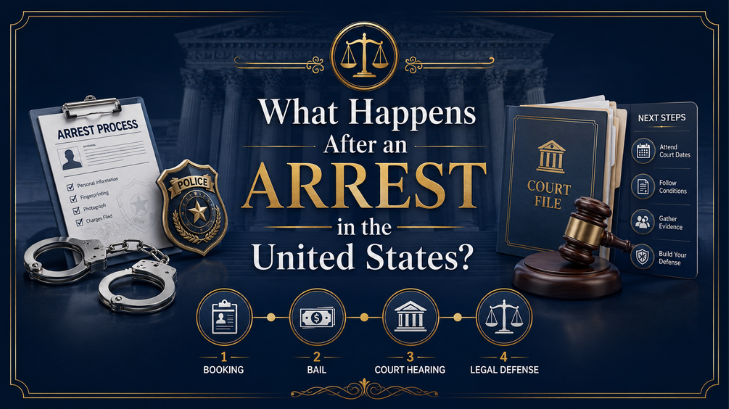
Below is a summary of the key stages that follow an arrest in the United States. Details vary by state, offense type, and local court rules, but most cases move through a series of important steps that may include booking, bail or release decisions, formal charges, and the first appearance before a judge. One of the most important early stages is the first court appearance after an arrest, where the court may explain the charges, address release conditions, and outline what happens next in the criminal process.
| Step | Stage | What Happens |
| 1 | Arrest | Police detain the suspect with or without a warrant |
| 2 | Booking | Fingerprints, photos, personal information recorded |
| 3 | Bail Hearing | Judge sets or denies bail (usually within 24–72 hours) |
| 4 | Arraignment | Formal reading of charges; defendant enters a plea |
| 5 | Preliminary Hearing / Grand Jury | Evidence reviewed to determine if case goes to trial |
| 6 | Pre-Trial Motions | Attorneys file motions to suppress evidence, dismiss, etc. |
| 7 | Plea Bargain or Trial | Defendant accepts deal or goes to trial before judge/jury |
| 8 | Sentencing | If convicted, judge determines punishment |
Step 1: The Arrest
An arrest occurs when a law enforcement officer takes a person into custody. This can happen in several ways:
- With an arrest warrant issued by a judge
- Without a warrant, if the officer has probable cause to believe a crime was committed
- At the scene of an alleged crime
At the moment of arrest, you have constitutional rights under the Fourth, Fifth, and Sixth Amendments to the U.S. Constitution. Officers are required to inform you of your Miranda rights before conducting a custodial interrogation. These rights include:
- The right to remain silent
- The warning that anything you say can be used against you in court
- The right to have an attorney present during questioning
- The right to a court-appointed attorney if you cannot afford one
Important: You do not have to answer questions beyond providing basic identification information in most states. Staying calm and clearly stating that you are invoking your right to remain silent is generally the safest step until you speak with an attorney.
Step 2: Booking and Processing
After the arrest, the officer transports the person to a local police station or jail for booking. This is an administrative process that typically includes:
- Recording your full name, date of birth, and personal information
- Photographing you (commonly known as a mugshot)
- Taking your fingerprints
- Conducting a background check
- Inventorying and securing your personal belongings
- Placing you in a holding cell or general population
In some jurisdictions, a blood or breath test may also be administered at this stage, particularly in DUI/DWI arrests. The booking process can take anywhere from one to several hours depending on the facility and circumstances.
Step 3: Bail Hearing and Release Options
One of the first major decisions after an arrest is whether you will be released while awaiting trial. In most cases, you will appear before a judge or magistrate for a bail hearing, often within 24 to 72 hours, where the court may review the seriousness of the charges, your criminal history, community ties, and any potential flight risk. Because future court appearances may be scheduled at this stage, it is also important to understand the consequences of missing a required hearing, as failing to appear can lead to additional penalties, a warrant, or stricter release conditions.
What Is Bail?
Bail is a financial amount set by the court that allows a defendant to be released from custody while the case proceeds. It is intended to ensure the person returns to court. If bail is paid and the defendant appears at all required court dates, the bail money is typically returned at the end of the case.
Types of Release
- Cash Bail: Full payment made directly to the court
- Bail Bond: A bail bondsman pays the bail in exchange for a non-refundable fee (usually 10%)
- Own Recognizance (OR): Released without payment, based on a promise to appear
- Supervised Release: Released with conditions such as check-ins, travel restrictions, or electronic monitoring
Judges consider factors like the severity of the offense, prior criminal history, community ties, flight risk, and public safety when setting bail. For serious felonies, bail may be denied entirely.
Step 4: Arraignment — Entering a Plea
The arraignment is a formal court hearing where the defendant is officially informed of the criminal charges filed against them. At this hearing, the defendant enters one of three pleas:
- Not Guilty: The defendant denies the charges and the case proceeds
- Guilty: The defendant admits to the charges and the case moves to sentencing
- No Contest (Nolo Contendere): The defendant does not admit guilt but accepts the punishment (not available in all states)
In most cases, defense attorneys advise entering a not guilty plea at arraignment, even if the defendant plans to negotiate a plea deal later. This preserves options and gives the defense time to review evidence.
Step 5: Preliminary Hearing or Grand Jury
Depending on the state and the type of offense, the case may proceed through one of two processes to determine if there is enough evidence to go to trial.
Preliminary Hearing
A judge reviews the prosecution’s evidence to determine whether probable cause exists to move forward. The defendant has the right to be present, and the defense may cross-examine witnesses. This is a critical stage where a skilled attorney can challenge weak or improperly obtained evidence.
Grand Jury
In federal cases and some states, a grand jury of civilians reviews evidence in private and decides whether to issue an indictment. The defendant is not present, and the standard is lower than at trial — grand juries indict in the majority of cases presented to them.
Yes. An arrest does not guarantee that charges will be filed. The prosecuting attorney reviews the case and decides whether the evidence is strong enough to proceed. If charges are dropped or the prosecutor declines to file, the case ends. An experienced criminal defense attorney may be able to present evidence or arguments that persuade the prosecutor not to proceed.
Step 6: Pre-Trial Motions and Discovery
Before trial begins, both sides exchange evidence in a process called discovery. The defense receives police reports, witness statements, lab results, surveillance footage, and other materials the prosecution intends to use.
Defense attorneys commonly file pre-trial motions, which are legal requests for the court to take specific action before trial. Common motions include:
- Motion to Suppress: Ask the court to exclude illegally obtained evidence
- Motion to Dismiss: Ask the court to throw out the case due to legal defects
- Motion for Change of Venue: Request the trial be moved due to pretrial publicity
These motions can dramatically affect the outcome of a case. A successful suppression motion, for example, can eliminate key evidence and sometimes lead to dismissal.
There is no single answer. Misdemeanor cases may resolve in weeks. Felony cases, especially serious ones, can take months or years. Factors that affect timing include case complexity, court backlog, the number of motions filed, and whether the case settles through a plea agreement. Under the Sixth Amendment, defendants have the right to a speedy trial, but what qualifies as ‘speedy’ varies by jurisdiction.
Step 7: Plea Agreement or Trial
The majority of criminal cases in the United States are resolved through plea bargains rather than trials. In a plea bargain, the defendant agrees to plead guilty (often to a lesser charge) in exchange for a reduced sentence or dismissal of other charges.
Going to Trial
If no agreement is reached, the case goes to trial. The defendant has the right to a trial by jury in most criminal cases. At trial:
- The prosecution presents its case first
- The defense may cross-examine witnesses and present its own evidence
- The defendant has the right not to testify
- The jury (or judge in a bench trial) decides guilt or innocence
- The prosecution must prove guilt beyond a reasonable doubt
Step 8: Sentencing
If the defendant is found guilty — whether through a trial verdict or a guilty plea — the case moves to sentencing. A judge imposes a sentence based on factors including:
- The severity of the offense
- State sentencing guidelines
- The defendant’s criminal history
- Mitigating or aggravating circumstances
- Victim impact statements
Possible sentences include fines, probation, community service, jail, prison, or a combination. In some states, defendants may be eligible for diversion programs, drug courts, or expungement after completing their sentence.
After an arrest in the U.S., you have the right to remain silent, the right to an attorney, the right to a bail hearing, the right to know the charges against you, and the right to a speedy and public trial. These rights are protected by the U.S. Constitution. Invoking them clearly and early — without aggression — is important.
Common Mistakes to Avoid After an Arrest
What you do immediately after an arrest can significantly affect your case, especially when the allegations involve serious offenses such as impaired driving charges, drug-related offenses, assault, theft, or other criminal accusations. Even small mistakes in the early stages of a case can influence bail decisions, evidence issues, plea discussions, and the overall defense strategy. Here are the most common errors people make after an arrest and the consequences they can lead to:
| Common Mistake | Potential Consequence |
| Resisting arrest | Can lead to additional criminal charges |
| Talking without an attorney | Statements can be used against you in court |
| Missing court dates | Results in a bench warrant and possible jail time |
| Violating bail conditions | Bond revoked; you may be held until trial |
| Posting on social media | Posts can be subpoenaed and used as evidence |
Yes, arrests — even those that did not result in conviction — can appear on background checks in many states. However, some states allow individuals to petition for expungement or sealing of arrest records. The rules vary widely by state and offense. Speaking with an attorney about record-sealing eligibility is advisable if you are concerned about background check impacts.
State-Specific Variations in the Criminal Arrest Process
While the broad stages described above apply across the United States, specific rules differ meaningfully from state to state. For example:
- Some states require a preliminary hearing; others use grand juries for felonies
- Bail amounts and release conditions vary widely by jurisdiction
- Arraignment timelines differ — some states require arraignment within 24 hours, others allow 72 hours or more
- The availability of diversion programs, drug courts, and mental health courts varies by county and state
- Sentencing guidelines, mandatory minimums, and parole rules differ significantly
Always consult with an attorney licensed in your state, or the relevant official state court website, for accurate information about procedures in your jurisdiction.
An arrest is a physical act — law enforcement takes a person into custody. Being charged is a legal act — the prosecutor formally files criminal charges. Being arrested does not automatically mean you will be charged. The prosecutor reviews the evidence and decides independently whether to pursue a case. Some arrests result in no charges being filed.
When Should You Contact a Criminal Defense Attorney?
The answer is: as soon as possible after an arrest. A qualified criminal defense attorney can:
- Advise you on your rights before and during questioning
- Represent you at bail hearings to seek lower bail or release on recognizance
- Review the evidence and identify weaknesses in the prosecution’s case
- File motions to suppress illegally obtained evidence
- Negotiate plea deals or prepare a defense strategy for trial
- Guide you through post-conviction options such as appeals or expungement
You do not need to wait until charges are filed. Contacting a lawyer immediately after arrest protects your rights from the very first stage of the process.
Have questions about a legal issue? Explore your rights, understand potential solutions, and find helpful guidance through the US Legal Journal.
Frequently Asked Questions (FAQs)
1. Can I be arrested without a warrant?
Yes. Police can arrest someone without a warrant if they have probable cause — a reasonable belief, based on facts, that a crime has been or is being committed. Warrantless arrests are common and legally valid in many situations, including when a crime is committed in the officer’s presence.
2. What happens if I cannot afford bail?
If you cannot afford bail, you may remain in jail until your case is resolved. However, options exist: a bail bondsman may post bond for a non-refundable fee, or your attorney may petition the court to reduce bail or request release on your own recognizance. Bail assistance programs exist in some counties.
3. How long can the police hold me before charging me?
Most states require a person to be brought before a judge within 48 to 72 hours of arrest. If no charges are filed within that time, the person is generally released. Federal law has its own timelines. The specifics depend on your state and the circumstances of the arrest.
4. Will an arrest go on my permanent record?
Arrests can appear on criminal records and background checks, even without a conviction. Some states allow arrests without conviction to be expunged or sealed. The eligibility rules vary. Speak with an attorney about whether your arrest record may qualify for sealing or expungement in your state.
5. What is the difference between a misdemeanor and a felony arrest?
Misdemeanors are less serious crimes (such as petty theft or simple assault) typically punishable by up to one year in jail. Felonies are more serious offenses (such as robbery or assault with a weapon) that carry penalties of over one year in state or federal prison. The arrest process is similar, but timelines, bail amounts, and court procedures typically differ.
6. Do I have to answer questions after being arrested?
No. You have the right to remain silent under the Fifth Amendment. You are generally not required to answer questions beyond providing basic identifying information in most states. Clearly state that you are invoking your right to remain silent and that you want an attorney present before any questioning.
The Bottom Line
Understanding what happens after an arrest in the United States can make a significant difference in how you navigate a frightening and high-stakes situation. The criminal arrest process follows a defined sequence — from booking and bail to arraignment, pre-trial motions, and potentially trial — but each stage carries legal complexity and consequences that vary by state.
Whether you or a loved one has been arrested, or you are simply preparing yourself with information, the most important step you can take is to speak with a qualified criminal defense attorney as early as possible. Protecting your rights starts at the moment of arrest — and an experienced lawyer can guide you through every stage of the process.
External Source Suggestions
U.S. Courts (uscourts.gov): Official overview of the federal criminal process, rights of defendants, and court procedures.
American Bar Association (americanbar.org): Resources on criminal law, finding attorneys, and understanding legal rights after arrest.
Legal Information Institute — Cornell Law School (law.cornell.edu): Plain-language explanations of Miranda rights, bail, arraignment, and constitutional protections.
Justice.gov — U.S. Department of Justice: Information on federal criminal procedures, civil rights, and law enforcement standards.
Your State Court Website: State-specific criminal procedure rules, court forms, and local public defender resources.
This article is for general informational purposes only and does not provide legal advice. It does not create an attorney-client relationship and does not guarantee any legal outcome, benefit, or result. Laws, procedures, and timelines vary by state, city, court, agency, and individual situation. For advice about your specific legal issue, speak with a qualified criminal defense attorney or the appropriate government agency in your jurisdiction.