Starting a new business in the United States means making dozens of decisions before you ever open your doors. One of the most important — and often most confusing — is choosing the right legal structure. For most entrepreneurs, the choice comes down to LLC vs corporation: two entities that offer legal protection, but work very differently in practice.
Your choice of business entity affects how much you pay in taxes, how much paperwork you file, how you bring in investors, and what happens to your personal assets if things go wrong. Getting this decision right early can save thousands of dollars and significant legal headaches down the road.
This guide explains the core differences between an LLC and a corporation in plain English, highlights what matters most for small business owners and startups, and helps you ask the right questions before you meet with a business attorney.
Quick Answer
An LLC (Limited Liability Company) offers flexible management, pass-through taxation, and fewer formalities — making it a popular choice for small businesses and solo entrepreneurs. A corporation is more structured, may offer advantages for raising investment capital, and can elect S-corp tax treatment. The best choice depends on your goals, your industry, how many owners are involved, and how you plan to grow. Laws and tax rules vary by state, so speaking with a qualified business attorney is always recommended before you file.
Quick Summary
- Both LLCs and corporations protect personal assets from most business debts and lawsuits.
- LLCs are generally easier and less expensive to form and maintain than corporations.
- Corporations are typically better suited for businesses seeking venture capital or planning to go public.
- Tax treatment differs significantly: LLCs default to pass-through taxation; corporations face potential double taxation unless they elect S-corp status.
- State laws govern both entity types — costs, filing requirements, and protections vary by state.
- Consulting a business attorney before choosing your structure is strongly recommended.
What Is an LLC?
A Limited Liability Company (LLC) is a legal business structure authorized under state law. It combines elements of a sole proprietorship or partnership with some of the liability protections found in corporations. The owners of an LLC are called members.
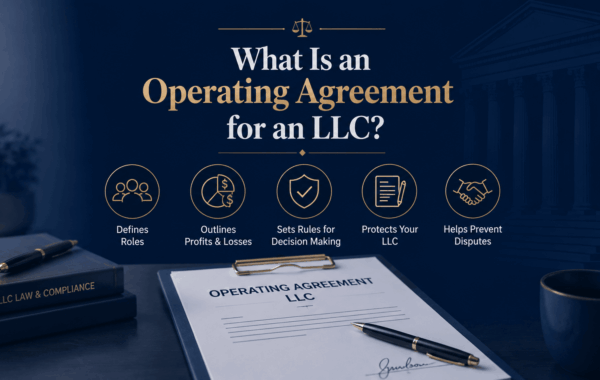
LLCs are governed by an operating agreement the agreement that governs LLC ownership and explains how the business is managed, financed, and operated. Some states require this document, while others do not, but having one is still considered a best practice because it can help define ownership rights, management responsibilities, profit distribution, voting rules, and dispute-resolution procedures.
One of the main attractions of an LLC is pass-through taxation. This means the business itself generally does not pay federal income taxes. Instead, profits and losses pass through to the members, who report them on their personal tax returns. This avoids the “double taxation” that traditional corporations can face. Business owners should also be careful when drafting or signing agreements, since common contract mistakes small businesses make can create legal and financial problems later.
What Protects You in an LLC?
The “limited liability” in an LLC means that members are generally not personally responsible for the debts and legal obligations of the business — as long as you keep business and personal finances separate and do not engage in fraud. Courts can sometimes “pierce the corporate veil” and hold owners personally liable if they blur the lines between personal and business activity.
What Is a Corporation?
A corporation is a separate legal entity owned by shareholders. It can enter contracts, own property, sue, and be sued — independent of its owners. Corporations have a formal structure: shareholders own the company, a board of directors oversees policy and major decisions, and officers handle day-to-day management.
There are two main types relevant to small businesses and startups:
- C-Corporation (C-Corp): The default corporate structure. C-corps pay corporate income tax on profits. When dividends are paid to shareholders, those shareholders also pay personal income tax on that income — this is the “double taxation” often cited as a drawback.
- S-Corporation (S-Corp): A tax designation available to qualifying corporations (and sometimes LLCs) that allows income to pass through to shareholders’ personal tax returns, similar to an LLC. S-corps have strict eligibility rules — for example, they cannot have more than 100 shareholders, and all shareholders must be U.S. citizens or residents.
Key Differences: LLC vs Corporation
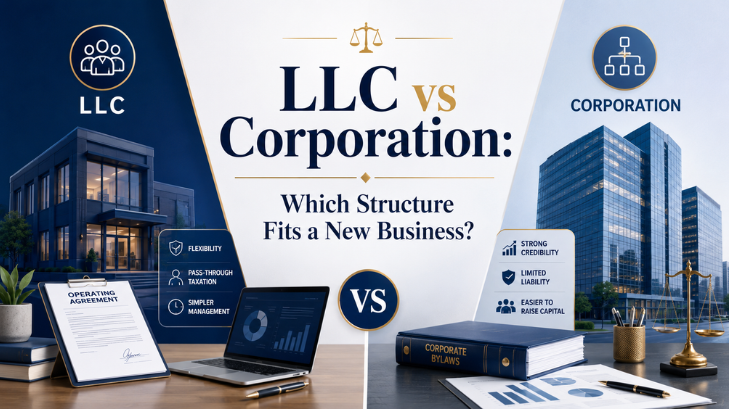
Understanding the comparison of LLC vs corporation requires looking at several factors side by side.
| Factor | LLC | Corporation |
| Owners | Called members | Called shareholders |
| Formation Ease | Generally simpler and lower cost | More complex; requires bylaws, board, etc. |
| Management | Flexible; members or managers | Formal; board of directors + officers |
| Taxation (Default) | Pass-through to members | C-corp: double taxation; S-corp: pass-through |
| Investor Friendliness | Less preferred by VC investors | Preferred by venture capital investors |
| Paperwork / Formalities | Fewer ongoing requirements | Annual meetings, board minutes, more filings |
| Self-Employment Tax | Members may owe SE tax on all profits | S-corp may reduce SE tax with salary structure |
| Stock Issuance | Cannot issue stock | Can issue multiple classes of stock |
| Going Public (IPO) | Not typical | C-corp is the standard for IPOs |
| State Costs | Varies by state | Varies by state; generally higher |
LLC or Corporation for Small Business?
For many small business owners and solo entrepreneurs, an LLC is the more practical starting point. Here is why:
- Lower formation and maintenance costs in most states
- Less paperwork — no required annual meetings or board minutes in most states
- Flexible profit distribution among members
- Pass-through taxation avoids the complexity of corporate tax returns for most small operations
That said, a corporation may make more sense in certain situations:
- You plan to seek funding from venture capital firms or angel investors, who often prefer or require a C-corp (especially a Delaware C-corp)
- You have plans to eventually issue stock options to employees
- You anticipate an IPO or acquisition by a larger public company
- You want to take advantage of specific corporate tax benefits available only to C-corps
The question of LLC or corporation for small business does not have a universal answer. The right entity depends on your industry, growth plans, number of owners, and how you intend to be taxed.
How Taxes Work: LLC vs Corporation
LLC Taxation
By default, a single-member LLC is taxed as a sole proprietorship. A multi-member LLC is taxed as a partnership. In both cases, income passes through to the owners’ personal tax returns and is taxed at individual rates. LLCs can also elect to be taxed as a corporation — either a C-corp or an S-corp — by filing the appropriate IRS forms.
One important consideration: LLC members who are active in the business typically owe self-employment taxes (currently 15.3% on the first $168,600 of net earnings in 2024, with different rates above that threshold) on their entire share of business profits.
Corporation Taxation
A standard C-corporation pays corporate income tax at the federal rate of 21% (as of 2024 under the Tax Cuts and Jobs Act). When the company pays dividends to shareholders, those shareholders also pay personal income tax on the dividends received — this is the double taxation concern.
An S-corporation avoids double taxation by passing income through to shareholders’ personal returns. However, S-corp shareholders who work in the business must pay themselves a “reasonable salary” subject to payroll taxes. The remainder can be distributed as dividends, potentially reducing self-employment tax exposure compared to an LLC.
Common Mistakes When Choosing a Business Structure
Choosing the right business structure is an important step, but new business owners often focus only on taxes or filing costs and overlook long-term legal responsibilities. The wrong structure can affect personal liability, ownership control, investor options, and how disputes are handled as the business grows. It is also important to review early agreements carefully, because contract mistakes that can hurt a new business may create confusion over payment terms, partner duties, intellectual property rights, or termination rules.
- Choosing based only on what a friend or online forum recommends, without considering your specific business model
- Ignoring state-specific filing costs and annual fees, which vary significantly
- Not drafting an operating agreement (LLC) or shareholder agreement (corporation), leading to disputes later
- Mixing personal and business finances after formation, which can eliminate your liability protection
- Selecting a structure now without a plan to convert as the business grows
- Failing to register in states where you actually conduct business
When Should You Speak with a Business Attorney?
Choosing a business entity has long-term legal and tax consequences. You should consult a qualified business attorney if:
- You have multiple co-owners or partners with unequal contributions or roles
- You are seeking outside investment or financing
- Your business operates in multiple states
- You are in a regulated industry such as healthcare, legal services, finance, or real estate
- You have questions about intellectual property ownership
- You are unsure whether an LLC or corporation better fits your exit strategy
A business attorney can review your specific situation and help you choose the structure that best protects your interests now and in the future.
The Bottom Line
The decision between an LLC vs corporation is one of the most important early choices a new business owner will make. LLCs offer simplicity, flexibility, and tax efficiency for most small businesses. Corporations provide a framework better suited for raising capital, issuing stock, and eventually going public. Neither is universally better — the right choice depends on your goals, your ownership structure, your tax situation, and the state where you operate.
If you are starting a business and weighing your options, take time to research the rules in your state, understand the tax implications for your situation, and speak with a qualified business attorney before you file. Getting the foundation right from the start gives your business the best chance for long-term success.
From understanding your rights to identifying possible next steps, US Legal Journal provides useful legal information for people across the United States.
Frequently Asked Questions (FAQs)
How much does it cost to form an LLC or corporation?
Costs vary by state. LLC formation fees range from roughly $50 to $500 in most states. Corporations generally cost more due to additional filing requirements. Many states also charge annual report fees or franchise taxes. Always check your specific state’s Secretary of State website for current fees.
Can I convert an LLC to a corporation later?
Yes, in most states you can convert an LLC to a corporation through a statutory conversion or by forming a new corporation and transferring assets. Tax implications apply. You should work with an attorney and a CPA before converting to understand all consequences.
Do I need an EIN for my LLC or corporation?
Yes. Both LLCs and corporations generally need an Employer Identification Number (EIN) from the IRS to open business bank accounts, hire employees, and file taxes. Single-member LLCs with no employees can sometimes use the owner’s Social Security Number, but an EIN is still strongly recommended for separation of personal and business finances. You can apply for an EIN free of charge at IRS.gov.
What is the difference between an LLC and an S-corp?
An S-corp is a tax designation, not a separate type of business entity. Both an LLC and a corporation can elect S-corp tax treatment with the IRS by filing Form 2553. The S-corp election allows income to pass through to owners’ personal returns and can reduce self-employment tax for owners who pay themselves a reasonable salary. Not all businesses qualify for S-corp status.
Is a corporation better for raising money?
Generally, yes. Venture capital firms and many institutional investors prefer or require C-corporations, particularly Delaware C-corps. Corporations can issue multiple classes of stock, including preferred shares that investors often require. LLCs can raise money, but their structure is less familiar to many institutional investors, and some fund structures are prohibited from holding LLC interests.
Do I need a lawyer to form an LLC or corporation?
You are not legally required to hire an attorney to file formation documents. However, working with a business attorney is strongly recommended because the choice of structure has long-term tax, liability, and operational consequences. Errors in operating agreements, shareholder agreements, or initial filings can be costly to fix later. Legal fees for basic business formation are often modest and well worth the investment.
People Also Ask
Is it better to start an LLC or a corporation?
For most new small businesses, an LLC is simpler and less expensive to form and maintain. Corporations are generally better suited for businesses planning to raise venture capital, issue stock options, or pursue an IPO. Your specific situation, industry, and growth goals should guide the decision — a business attorney can help you weigh these factors.
Does an LLC pay less tax than a corporation?
It depends on the circumstances. LLCs with pass-through taxation avoid corporate income tax, but active members owe self-employment taxes on profits. An S-corp election — available to LLCs and qualifying corporations — can sometimes reduce the overall tax burden for profitable businesses by allowing owner-employees to split income between salary and distributions. Always consult a tax professional for your specific situation.
What is the main disadvantage of an LLC?
The primary downsides of an LLC include self-employment taxes on active owner income, less attractiveness to venture capital investors who typically prefer C-corps, restrictions on types of owners in some states, and fewer established legal precedents in some jurisdictions compared to corporations. Laws vary by state.
Can a single person form an LLC or corporation?
Yes. Both entities can be formed by a single individual. A single-member LLC is a common choice for solo business owners and freelancers. A single-shareholder corporation is also legally permitted in all U.S. states. The requirements for formation and maintenance differ by state.
Which states are best for forming an LLC or corporation?
Delaware is a popular choice for corporations due to its well-developed business courts and corporate laws. Wyoming and Nevada are popular for LLCs due to low fees and strong privacy protections. However, if your business operates primarily in your home state, you may need to register there as a foreign entity regardless — adding cost. Your home state may be the most practical option for small businesses.
This article is for general informational purposes only and does not provide legal advice. Laws and procedures may vary by state, city, court, agency, or individual situation. For advice about your specific legal issue, speak with a qualified attorney or the appropriate government agency.