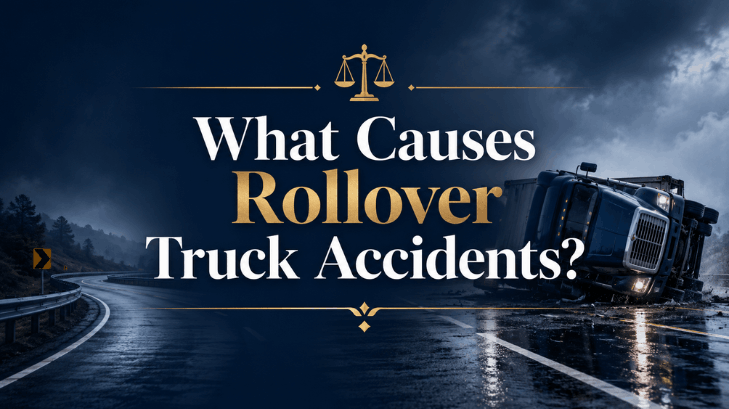
Large trucks don’t tip over for no reason. When you see a tractor-trailer lying on its side on the highway, something specific went wrong — usually a combination of speed, an unstable load, a sudden steering correction, or a mechanical problem. Understanding what causes a rollover truck accident can help you make sense of what happened, especially if you or someone you know was involved in one.
This matters because rollover crashes are not just dramatic; they’re often severe. A fully loaded semi-truck can weigh up to 80,000 pounds, and when it rolls, nearby vehicles, cargo, and roadway debris can cause serious harm. Knowing the common causes also helps readers understand why these crashes happen so often near highway ramps and curves.
This article explains the main causes of rollover truck accidents, who may be involved, what evidence typically matters, and when it may help to speak with an attorney. It is written for general education, not as a substitute for legal advice about a specific situation.
Quick Answer
A rollover truck accident usually happens when a truck travels too fast for a curve or ramp, the driver makes a sudden steering correction, the cargo load is unstable or improperly secured, or a mechanical part such as tires or brakes fails. Federal crash data shows that excessive speed and driver inattention are involved in a large share of truck rollovers, with cargo and loading problems as another major contributing factor. Multiple causes often combine in a single crash.
Quick Summary
- Speed is the single biggest factor in rollover truck accidents, especially on highway ramps and curves.
- Driver inattention, fatigue, and abrupt steering corrections are also major contributors identified in federal crash research.
- An unsecured, overloaded, or top-heavy cargo load raises a truck’s center of gravity and increases rollover risk.
- Mechanical failures — such as tire blowouts, brake problems, or worn suspension parts — can trigger a rollover even without driver error.
- Liability can fall on the truck driver, the trucking company, a cargo loading company, or a parts manufacturer, depending on the cause.
- Laws and filing deadlines vary by state, so it’s important to speak with a qualified attorney about your specific situation.
What Is a Rollover Truck Accident?
A rollover truck accident happens when a commercial truck tips onto its side or roof during a turn, sudden maneuver, or loss of control. The Federal Motor Carrier Safety Administration (FMCSA) describes this type of crash as an “overturn,” involving one or more quarter-turns of the vehicle around its long axis.
Tractor-trailers are more prone to this than passenger cars because of their height, weight distribution, and high center of gravity. When a truck travels around a curve, centrifugal force pushes the body of the vehicle outward and upward. If that force is greater than what the tires and suspension can handle, the truck tips over.
Who Is Affected by Rollover Truck Accidents?
Rollover crashes can affect several people at once, including:
- The truck driver, who may be injured or killed in the cab.
- Occupants of nearby passenger vehicles, who may be struck by the truck, its trailer, or spilled cargo.
- Pedestrians or cyclists near the crash site, particularly in urban areas or near exit ramps.
- Other commercial drivers, if a rollover blocks multiple lanes or causes a chain-reaction crash.
Because of the size and weight of large trucks, a rollover can affect a wide area, especially if the trailer was carrying hazardous materials, loose freight, or a liquid load that shifted suddenly.
Main Causes of Rollover Truck Accidents
Federal crash investigators, including FMCSA and NHTSA, have studied truck rollovers in detail through programs such as the Large Truck Crash Causation Study. Their research points to several recurring causes, which often combine rather than act alone.
1. Excessive Speed for Road Conditions
Speed is consistently identified as the leading factor in rollover crashes. This doesn’t always mean speeding above the posted limit — it often means driving too fast for a specific curve, ramp, or weather condition. Highway interchange ramps are a frequent rollover location because drivers misjudge how sharply the road curves relative to their speed.
2. Driver Inattention or Distraction
Looking away from the road, using a phone, adjusting equipment, or simply losing focus for a few seconds can be enough for a truck to drift out of its lane. When a driver overcorrects after drifting, the sudden steering input can cause the trailer to tip.
3. Steering Errors and Overcorrection
Oversteering, understeering, and overcorrecting are each linked to rollover crashes. A driver who jerks the wheel too sharply to avoid an obstacle, return to a lane, or respond to a tire blowout can unintentionally cause the trailer to roll, even at moderate speeds.
4. Cargo Loading Problems
An unevenly distributed, overloaded, or poorly secured load raises a truck’s center of gravity and makes it less stable. This is a well-documented issue with tanker trucks carrying liquids, since the load can slosh from side to side during turns, shifting weight unpredictably. Loose or improperly secured freight can have a similar effect.
5. Driver Fatigue and Hours-of-Service Violations
Long-haul driving schedules can lead to drowsy driving, slower reaction times, and reduced ability to judge curves correctly. Federal hours-of-service rules exist in part to limit these risks, but fatigue-related rollovers still occur, particularly during overnight driving.
6. Impaired Driving
Alcohol or drug impairment reduces a driver’s ability to judge speed and steering input accurately. Impairment has been linked to a meaningful share of fatal rollover crashes in federal data.
7. Mechanical Failures
Tire blowouts, worn brakes, suspension defects, or steering system failures can cause a rollover independent of driver behavior. These issues may point to a maintenance failure by the trucking company or a defect from a parts manufacturer.
8. Adverse Weather and Road Conditions
Wet, icy, or uneven road surfaces reduce tire traction, making it easier for a truck to lose control during a turn. Wind gusts can also push against the broad side of a trailer, especially when it is empty or lightly loaded.
Rollover accidents share some causes with another serious truck crash type. To understand a related but distinct hazard, see our guide on what causes jackknife truck accidents, which explains how sudden braking and trailer swing can lead to a different kind of loss of control.
Common Real-World Scenarios
People searching for information about rollover truck accidents often describe situations like these:
- A tanker truck rolled over while exiting a highway ramp, and the driver said the load “shifted.”
- A loaded semi-truck tipped over after the driver swerved to avoid a stalled car.
- A trucking company’s vehicle rolled over after a tire blew out on the highway.
- A driver fell asleep on a long overnight route and the truck rolled after drifting off the road.
Each of these scenarios may involve different parties and different evidence, which is why early documentation matters.
Evidence That Often Matters in a Rollover Truck Accident Case
If you were involved in or affected by a rollover truck accident, certain types of evidence are commonly used to understand how the crash happened. The table below summarizes common evidence categories.
| Evidence Type | Why It May Matter |
| Police crash report | Provides an official record of the scene, parties involved, and initial findings. |
| Truck’s electronic logging device (ELD) data | May show speed, braking, and hours-of-service compliance leading up to the crash. |
| Cargo loading and weight records | Can help show whether the load was overweight, unbalanced, or improperly secured. |
| Truck maintenance records | May reveal whether tires, brakes, or suspension parts were inspected and maintained. |
| Witness statements | Can describe the truck’s speed, movement, or behavior before the rollover. |
| Photos and video of the scene | Help preserve details about road conditions, skid marks, and vehicle positions. |
| Medical records | Document injuries and their connection to the crash. |
Legal Considerations After a Rollover Truck Accident
Liability in a rollover truck accident depends heavily on the facts. In general, responsibility may fall on one or more of the following parties:
- The truck driver, if speeding, distraction, fatigue, or impairment played a role.
- The trucking company, if poor training, scheduling pressure, or inadequate maintenance contributed to the crash.
- A cargo loading company, if the load was improperly secured or unevenly distributed.
- A parts manufacturer, if a defective tire, brake system, or suspension component failed.
These are general possibilities, not legal conclusions about any specific crash. Determining liability typically requires a detailed review of the crash investigation, vehicle data, and applicable state law.
It’s also useful to understand how a truck accident claim differs from a typical car accident claim, since trucking cases often involve federal safety regulations and multiple potentially responsible parties.
Our related article, truck accident vs. car accident claims, explains these differences in more detail.
Timelines and Deadlines
Every state sets its own deadline, known as a statute of limitations, for filing a personal injury or wrongful death claim after a crash. These deadlines vary widely depending on the state and the type of claim, and missing one can affect a person’s ability to pursue a case. Because rules differ from state to state and can change, readers should confirm the current deadline that applies to their situation with a licensed attorney or their state court’s official resources.
Mistakes to Avoid After a Rollover Truck Accident
| Common Mistake | Why It Can Be a Problem |
| Not documenting the scene | Skid marks, debris, and vehicle position can change or disappear quickly. |
| Giving a recorded statement to an insurer too early | Statements made before all facts are known can be used later in ways that don’t reflect what actually happened. |
| Delaying medical treatment | Some injuries aren’t obvious right away, and delayed care can create gaps in medical records. |
| Waiting too long to seek legal guidance | Important evidence, such as ELD data, may be erased or overwritten if not requested promptly. |
| Assuming the cause is obvious | Multiple factors often combine in a rollover, and the true cause may only emerge after investigation. |
When to Speak With an Attorney
Rollover truck accident cases are often more complex than standard car accident claims because they can involve federal trucking regulations, multiple companies, and technical evidence like cargo manifests or maintenance logs. It may be worth speaking with a qualified personal injury or trucking accident attorney if:
- You or a family member were seriously injured in a rollover crash.
- A loved one was killed in a truck rollover.
- You’re unsure who may be responsible for the crash.
- An insurance company has contacted you about a settlement.
- Important evidence, such as data from the truck’s onboard systems, may need to be preserved quickly.
An attorney can review the specific facts of a case and explain the legal options that may apply under the relevant state’s laws.
Practical Next Steps
- Seek medical attention, even if injuries seem minor at first.
- Keep copies of police reports, medical records, and any photos from the scene.
- Avoid giving detailed statements to insurance adjusters before speaking with an attorney.
- Note the truck company’s name, USDOT number, and license plate if visible.
- Contact a licensed attorney in your state to discuss your specific situation and any applicable deadlines.
Understanding Rollover Truck Accident Causes: What to Do Next
A rollover truck accident rarely has just one cause. In most cases, speed, driver attention, cargo stability, and vehicle condition all play a role, and federal crash data consistently points to these same factors across thousands of incidents. Recognizing these causes can help readers understand what may have happened in a specific crash and what kinds of evidence are often relevant.
If you or someone you know was affected by a rollover truck accident, the most useful next step is usually to document what happened, seek any necessary medical care, and speak with a qualified attorney who can review the specific facts of the situation under your state’s laws. Acting early can help preserve evidence and protect your options going forward.
People Also Ask
What is the most common cause of truck rollovers?
Excessive speed for the road or curve is the most consistently cited factor in federal crash research on truck rollovers. This often involves a driver misjudging how fast they can safely take a highway ramp or curve, especially with a loaded trailer. Driver inattention and cargo-related issues are also frequent contributing factors.
Can a truck rollover happen without driver error?
Yes. Mechanical failures, such as a tire blowout, brake failure, or a suspension defect, can cause a rollover even when the driver does everything correctly. In these cases, the trucking company or a parts manufacturer may share responsibility, depending on what the investigation finds.
Are rollover accidents more dangerous than other truck accidents?
Rollover crashes are often associated with serious injuries because of the truck’s size and the way cargo and the vehicle itself can affect a wide area. However, the severity of any crash depends on speed, location, and the vehicles involved, so outcomes vary case by case.
Who investigates the cause of a truck rollover?
Local or state police typically conduct the initial crash investigation. In serious crashes, federal agencies such as the FMCSA may also become involved, particularly if there are concerns about regulatory violations, such as hours-of-service or vehicle maintenance issues.
Does cargo type affect rollover risk?
Yes. Loads that can shift, such as liquids in tanker trucks or loosely secured freight, are commonly linked to rollover risk because they change the truck’s center of gravity unpredictably during turns. Properly secured, evenly distributed cargo is generally more stable. court where the original case was handled. Each state only has authority over records within its own court system.
Frequently Asked Questions
Is a rollover the same as a jackknife accident?
No. A rollover happens when the truck tips onto its side or roof, while a jackknife crash happens when the trailer swings out and folds against the cab, usually during hard braking. Some crashes involve elements of both. Our guide on jackknife truck accidents explains that crash type in more detail.
Can weather alone cause a rollover?
Weather is rarely the sole cause, but it can combine with other factors. Wet or icy roads reduce traction, and strong winds can push against an empty or lightly loaded trailer, increasing the chance that a driver’s normal speed or steering becomes unsafe for the conditions.
What should I do if I witness a truck rollover?
If it’s safe to do so, call 911, stay a safe distance away in case of leaking fuel or cargo, and avoid approaching the truck directly. If you’re comfortable doing so, note details like the time, location, and what you observed, since witness accounts can be useful later.
Do rollover accidents always involve a lawsuit?
No. Many rollover accident situations are resolved through insurance claims without a lawsuit. Whether a lawsuit becomes necessary depends on the specific facts, the parties involved, and whether a fair resolution can be reached without going to court.
How long do I have to file a claim after a rollover truck accident?
Deadlines vary by state and depend on the type of claim, such as personal injury or wrongful death. Because these rules differ and can change, it’s important to confirm the applicable deadline with a licensed attorney or your state’s court system as soon as possible.
This article is for general informational purposes only and does not provide legal advice. Laws and procedures may vary by state, city, court, agency, or individual situation. For advice about your specific legal issue, speak with a qualified attorney or the appropriate government agency.