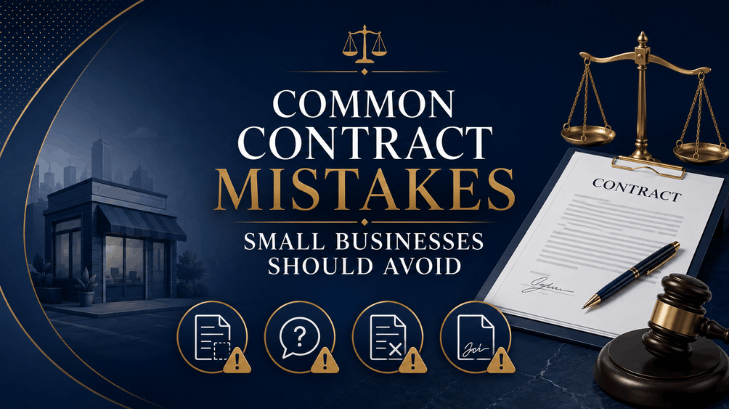
A single vague sentence in a vendor agreement. A missing payment deadline in a client contract. A handshake deal that was never put in writing. These small oversights are some of the most common contract mistakes small businesses make, and they can lead to disputes, lost income, or even lawsuits that drain time and money the business doesn’t have to spare.
Contracts are the backbone of nearly every business relationship, from hiring a contractor to leasing office space to selling goods online. When a contract is unclear, incomplete, or never reviewed, it stops protecting the business the way it should. Understanding small business contract mistakes before they happen is one of the simplest ways an owner can reduce legal and financial risk.
This article explains the most frequent contract errors small businesses encounter, why they matter, and the general steps owners can take to reduce risk. It does not replace advice from a licensed attorney, and laws vary by state.
Quick Answer
The most common contract mistakes small businesses make include relying on verbal agreements, using vague or undefined terms, leaving out payment and termination details, skipping dispute resolution clauses, and using generic templates that don’t match the business or its state’s laws. These gaps can make a contract harder to enforce and increase the risk of disputes. Because contract law varies by state, a business attorney can review an agreement before it’s signed.
Quick Summary
- Written contracts are generally easier to enforce than verbal agreements and reduce confusion between parties.
- Vague language, such as “reasonable time” or “best efforts,” is a leading cause of contract disputes.
- Missing payment terms, deadlines, and termination clauses are among the most frequent small business contract mistakes.
- Free or generic templates often don’t reflect a business’s specific needs or its state’s laws.
- Signing contracts in a personal name instead of the business’s name can put personal assets at risk.
- Reviewing contracts regularly helps a business stay protected as it grows and circumstances change.
What “Common Contract Mistakes” Means for Small Businesses
In general legal use, expungement refers to a court order that removes or seals a criminal record so that it is no longer visible in A contract mistake is any gap, ambiguity, or omission in a business agreement that weakens its enforceability or leaves a party exposed to unexpected risk. For small businesses, these mistakes often happen because contracts are drafted quickly, copied from a free template, or signed without a full review.
These issues affect a wide range of agreements, including:
Employment offer letters and non-disclosure agreements
Client and customer service agreements
Vendor and supplier contracts
Independent contractor and freelance agreements
Commercial lease agreements
Partnership and operating agreements
Employment offer letters and non-disclosure agreements
Who These Mistakes Affect
Contract mistakes can affect any small business, regardless of industry. Owners who handle their own contracts without legal review, or who use the same agreement across very different types of deals, tend to face the highest risk. New businesses are especially likely to rely on free online templates that were never written with a particular state’s laws or a particular industry in mind.
Most Common Contract Mistakes Small Businesses Make
1. Not Putting the Agreement in Writing
Relying on a verbal agreement or a casual email exchange instead of a signed contract is one of the most frequent small business contract mistakes. Some agreements, such as certain real estate or long-term contracts, generally must be in writing to be enforceable under a legal principle known as the statute of frauds, which varies by state. Even when a written contract isn’t strictly required, having one in place makes it far easier to prove what both sides agreed to if a dispute arises later.
2. Using Vague or Ambiguous Language
Phrases like “reasonable time,” “best efforts,” or “as needed” may sound standard, but they can be interpreted differently by each party. When a disagreement happens, a court will look at the contract’s actual wording, not what either side assumed it meant. Replacing vague language with specific dates, measurable standards, and clearly defined responsibilities reduces the chances of a dispute.
3. Leaving Out Clear Payment Terms
Missing or unclear payment terms are a leading cause of business disputes. A contract should state the exact payment amount, due dates, accepted payment methods, and any late fees or interest charges. Without these details, a business may have little recourse if a client or vendor pays late or not at all.
4. Skipping a Termination Clause
Many small business contracts focus on how the relationship begins but say little about how it can end. A termination clause should explain the notice period required to end the agreement, what counts as a breach of contract, and whether early termination fees apply. Without this clause, ending a contract that isn’t working out can become more complicated and costly than it needs to be.
5. Not Including a Dispute Resolution Process
Without a plan for resolving disagreements, even a minor dispute can turn into expensive litigation. Many contracts include a clause requiring mediation or arbitration before either party can file a lawsuit. This step can help resolve disagreements faster and at a lower cost, although it also means giving up some rights to go directly to court, which is worth discussing with an attorney before signing.
6. Relying on Free or Generic Templates
Free templates found online are often written for general situations and may not account for a specific industry, transaction type, or state law. A template built for a different kind of business can miss important protections, such as liability limits, indemnification language, or confidentiality provisions, that a particular agreement actually needs.
7. Overlooking Indemnification and Liability Provisions
Indemnification clauses determine who is financially responsible if a third party brings a claim related to the contract. Agreeing to broadly indemnify the other party, without limits, can expose a small business to liability far beyond what the deal is worth. Reviewing these clauses carefully, and limiting liability where appropriate, helps keep risk proportional to the size of the agreement.
8. Signing in a Personal Name Instead of the Business’s Name
When an owner signs a contract personally rather than as a representative of the LLC or corporation, it can blur the line between personal and business liability. Contracts should generally be signed using the business’s legal name and the signer’s title, to help keep the business entity’s liability protections intact.
9. Ignoring State and Local Law Differences
Contract law is largely governed at the state level, and rules can vary on issues such as non-compete enforceability, required disclosures, and interest rate limits on late payments. A contract that works in one state may not hold up the same way in another, which matters for businesses that operate or hire across state lines.
10. Failing to Review and Update Contracts Over Time
A contract written when a business first started may no longer reflect how the business actually operates years later. Regularly reviewing standard contracts, such as client agreements or vendor terms, helps make sure they still match current operations, pricing, and risk exposure.
Common Contract Mistakes
The table below summarizes frequent small business contract mistakes, why each one creates risk, and a general better approach.
| Common Mistake | Why It’s Risky | Better Approach |
| No written contract | Verbal promises are hard to prove and may be unenforceable for certain deals. | Put every business agreement in writing, even with people you trust. |
| Vague or undefined terms | Words like “reasonable time” or “best efforts” can be read differently by each side. | Use specific dates, dollar amounts, and measurable standards. |
| Missing payment terms | Unclear due dates or amounts often lead to late payments and disputes. | Spell out amount, due date, late fees, and accepted payment methods. |
| No termination clause | Without exit terms, ending a bad deal can be costly or legally unclear. | Add notice periods, termination triggers, and any exit fees. |
| Skipping dispute resolution | Every disagreement may end up in costly litigation. | Consider mediation or arbitration clauses to resolve issues faster. |
| Using a generic template | Free templates may not reflect your state’s laws or your business needs. | Customize templates and have them reviewed for your situation. |
| Signing in a personal name | This can expose personal assets instead of protecting the business entity. | Sign as an authorized representative of the LLC or corporation. |
| Not reviewing or updating | Contracts can become outdated as the business or law changes. | Review key contracts at least once a year or after major changes. |
Documents and Information to Gather Before Signing
Before signing or finalizing a business contract, it generally helps to have the following on hand:
- The full, final version of the contract, not just a summary or earlier draft
- Business formation documents (LLC or corporation registration) to confirm signing authority
- Pricing, scope of work, and timeline details discussed with the other party
- Insurance certificates, if the contract requires proof of coverage
- Any prior written communications that describe the deal’s terms
When to Speak With a Business Attorney
Not every contract requires a lawyer, but certain situations call for legal review before signing:
- The contract involves a large dollar amount or a long-term commitment
- The agreement includes indemnification, liability waivers, or non-compete clauses
- The other party provided the contract and it appears one-sided
- The deal involves real estate, intellectual property, or equity in the business
- A dispute has already started, or one side is threatening legal action
An attorney licensed in the relevant state can review the specific terms, explain how state law applies, and suggest changes before signing. Reaching out early is generally far less costly than resolving a dispute after the fact.
Practical Next Steps for Small Business Owners
- Put every significant business agreement in writing, even with familiar partners or clients.
- Replace vague language with specific numbers, dates, and defined responsibilities.
- Add clear payment terms, a termination clause, and a dispute resolution provision to standard contracts.
- Have a business attorney review or customize any template before it’s used regularly.
- Sign contracts under the business’s legal name, using an authorized title.
- Set a recurring reminder, such as annually, to review and update standard contracts.
Protect Your Business: Review Contracts Before You Sign
Common contract mistakes, like vague language, missing payment terms, and skipped termination clauses, are some of the most preventable risks a small business faces. Most of these issues don’t come from complicated legal problems; they come from contracts that were rushed, copied, or never reviewed in the first place.
Taking time to review agreements carefully, customize templates for your specific situation, and know when to bring in a licensed attorney can help your business avoid disputes before they start. Because contract law varies by state and by industry, speaking with a qualified business attorney about your specific agreement is the best next step before you sign.
Frequently Asked Questions
Do small business contracts need to be notarized?
Most standard business contracts don’t require notarization to be valid. Certain documents, such as some real estate transfers or specific state filings, may require it. Check your state’s requirements or ask an attorney if you’re unsure.
How often should a small business review its standard contracts?
There’s no single legal requirement, but many businesses review standard agreements at least once a year or whenever there’s a major change in operations, pricing, or applicable law.
Can a poorly written contract still be enforced?
It depends on the specific defects. Some unclear contracts are still enforceable, while others may be challenged or interpreted in ways that surprise one of the parties. An attorney can review a specific contract to assess enforceability.
Is it expensive to have an attorney review a small business contract?
Costs vary widely based on the attorney, the complexity of the contract, and the region. Many business attorneys offer flat-fee contract reviews or initial consultations, so it’s worth asking about cost upfront.
What is the difference between a contract template and a custom contract?
A template is a general starting document, while a custom contract is tailored to a specific deal, industry, and state’s laws. Templates can be a useful starting point but often need revisions before they fully protect a particular business. the state and court where the original case was handled. Each state only has authority over records within its own court system.
People Also Ask
Are verbal contracts legally binding for a small business?
In some cases, yes, but verbal contracts are difficult to prove and enforce, and certain agreements must be in writing under state law. Written contracts provide clearer evidence of what both parties agreed to and are generally easier to enforce if a dispute happens.
What should every small business contract include at a minimum?
Most business contracts should clearly identify the parties, describe the scope of work or goods, state payment terms, include a termination clause, and address how disputes will be resolved. Specific requirements vary by contract type and state, so reviewing with an attorney is recommended.
Can a small business owner use a free contract template safely?
A free template can be a starting point, but it often needs to be customized for the specific deal, industry, and state law. Using a generic template without review is a common contract mistake that can leave important protections out of the agreement.
What happens if a contract has unclear or ambiguous terms?
If a dispute arises, a court will generally interpret the contract based on its actual written language. Ambiguous terms can lead to outcomes neither party expected, which is why clear, specific wording is important when drafting or reviewing an agreement.
Does signing a contract personally instead of as a business put an owner at risk?
It can. Signing in a personal name rather than as a representative of the LLC or corporation may blur the liability protection the business entity is meant to provide. Contracts should generally be signed with the business name and the signer’s title.
This article is for general informational purposes only and does not provide legal advice. Laws and procedures may vary by state, city, court, agency, or individual situation. For advice about your specific legal issue, speak with a qualified attorney or the appropriate government agency.