Getting into a car accident is stressful enough without having to figure out who was legally responsible. Many people are surprised to learn that fault is not always obvious — insurance companies and courts rely on specific evidence, not just opinions, to decide who caused a crash.
Understanding what evidence proves fault matters because it can affect whether an insurance claim is approved, denied, or disputed. It can also shape the common car accident injuries a person is dealing with and how those injuries get documented for a claim.
This article explains, in plain language, the types of evidence typically used to establish fault, the role of car accident injury symptoms in a claim, and the general legal rules that can affect how compensation is calculated. It is not a substitute for advice from a licensed attorney.
Quick Answer
Fault after a car accident is typically established through a combination of the police crash report, photos and video, witness statements, vehicle damage patterns, and sometimes event data recorder (“black box”) information. Medical records documenting common car accident injuries also matter because they connect injuries to the crash. No single piece of evidence automatically proves fault — insurers and courts generally weigh the evidence together, and the exact process can vary by state.
Quick Summary
- Fault is usually determined by combining several types of evidence, not just one document or statement.
- A police report is helpful but is not always the final or only word on fault in a claim or lawsuit.
- Photos, video, and witness statements taken close to the time of the crash tend to carry more weight.
- Common car accident injuries, like whiplash or back pain, should be documented by a medical provider promptly.
- Most states use some form of comparative negligence, but a handful use contributory negligence — and this distinction can significantly affect a claim.
- Rules about fault, evidence, and deadlines vary by state, so confirming local rules with an attorney or official agency is important.
How Is Fault Determined After a Car Accident?
In most car accident cases, “fault” refers to which driver (or drivers) acted negligently — meaning they failed to use reasonable care while driving, and that failure caused the crash. Insurance adjusters, and sometimes judges or juries, generally look at the available evidence to reconstruct what happened and assign responsibility.
Fault is not always all-or-nothing. Depending on the state, more than one driver can share a percentage of fault, which can affect how much compensation an injured person may recover. This is discussed further in the section on state fault rules below.
Who Is Affected by Fault Determinations?
Fault findings can affect:
- Drivers and passengers involved in the crash
- Pedestrians or cyclists struck by a vehicle
- Insurance companies deciding whether to pay a claim
- Anyone pursuing or defending a personal injury claim or lawsuit related to the accident
Types of Evidence Commonly Used to Prove Fault
Below is a general overview of evidence that often plays a role in car accident fault determinations. Not every case will involve all of these, and what is available can depend heavily on the specific facts of the crash.
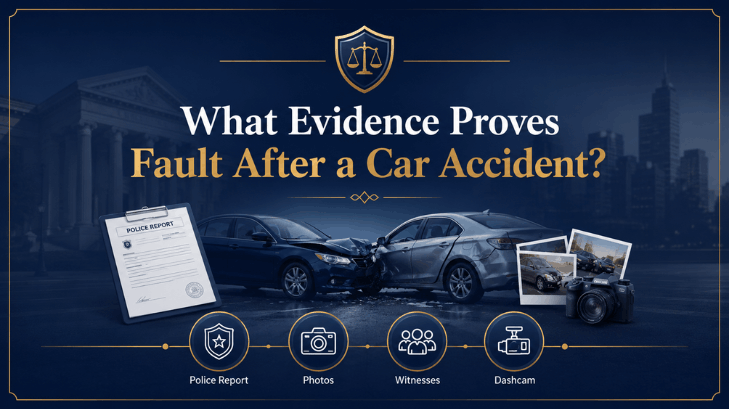
| Evidence Type | Why It Matters |
| Police crash report | Officers often record initial observations, statements, and sometimes a preliminary opinion on contributing factors. |
| Photos and videos | Images of vehicle damage, skid marks, road conditions, and traffic signals can show how the crash likely happened. |
| Witness statements | Independent witnesses can confirm details like speed, signals, or right-of-way that drivers may dispute. |
| Traffic and surveillance camera footage | Nearby businesses, intersections, or dash cams may capture the moments before and during the crash. |
| Vehicle damage and debris patterns | The location and type of damage can suggest the direction of impact and point of collision. |
| Event data recorder (“black box”) | Many modern vehicles store data on speed, braking, and steering in the seconds before a crash. |
| Medical records | Records connect the reported injuries to the accident date and document the treatment that followed. |
| Cell phone records | These may show whether a driver was texting, calling, or otherwise distracted at the time of the crash. |
| Citations or traffic violations | A ticket for speeding, running a light, or other violations can support a fault argument, though it is not always the final word. |
The Police Crash Report
When police respond to a crash, they typically prepare a report that includes basic facts: date, time, location, parties involved, and often a description of the damage and any visible injuries. Some reports include a section where the responding officer notes a suspected contributing factor or cites a driver for a traffic violation.
It is important to understand that a police report is evidence, not necessarily a final legal determination of fault. Insurance companies often give it significant weight, but it can be challenged or supplemented with other evidence if it is incomplete or inaccurate.
Photos, Video, and Physical Evidence
Photos of vehicle positions, skid marks, broken glass, and road or weather conditions can help establish how a collision likely occurred. If nearby businesses, traffic signals, or another driver’s dash cam captured the crash on video, that footage can be especially persuasive because it shows what happened in real time.
Witness Statements
People who saw the crash but were not involved in it can offer an independent account of what they observed, such as which driver had a green light or who appeared to be speeding. Witness contact information collected at the scene, or shortly after, tends to be more reliable than information gathered much later.
Event Data Recorders and Vehicle Technology
Many vehicles built in recent years include event data recorders that can capture information like speed, braking, and seatbelt use in the moments before a crash. This data is not available in every vehicle or every case, and accessing it may require a formal request or, in some situations, a court order.
Common Car Accident Injuries and Why They Matter to a Claim
Medical evidence does double duty in a car accident claim: it documents the severity of the harm and can support the timeline used to establish when and how the crash-related symptoms developed. Records identifying the injuries that often appear in crash claims may also help connect the collision to the treatment received, demonstrate the need for ongoing care, and support a claim for medical expenses and other losses. Some of the common car accident injuries people experience include:
- Whiplash and other neck injuries
- Back and spinal injuries, including herniated discs
- Concussions and other traumatic brain injuries
- Broken or fractured bones
- Cuts, bruises, and soft tissue injuries
- Psychological effects, such as anxiety after a crash
Recognizing car accident injury symptoms early matters because some injuries, such as whiplash or concussions, are not always obvious right after a crash. Symptoms like stiffness, headaches, dizziness, or back pain can appear hours or even days later. Seeking prompt medical evaluation helps create a documented link between the accident and the injury, which can be relevant if a claim is filed later.
This article provides general information only and does not diagnose or treat any injury. Anyone experiencing pain, dizziness, confusion, or other symptoms after a crash should seek evaluation from a qualified medical provider.
How State Fault Rules Can Affect a Claim
Once fault is assessed in a personal injury claim, the next question is often how that determination will affect the amount of compensation an injured person may recover. The percentage of responsibility assigned to each party can influence medical expense reimbursement, lost income, pain and suffering, and other recoverable damages, making fault a central factor in calculating a fair injury settlement. State negligence laws can also determine whether compensation is reduced, limited, or completely barred when the injured person shares some responsibility for the accident. Although the specific rules vary by jurisdiction, states generally follow one of a few approaches:
| Fault Rule | How It Works | General Examples |
| Pure comparative negligence | You can recover damages even if you were mostly at fault, reduced by your percentage of fault. | States such as California, New York, and Florida generally use this approach. |
| Modified comparative negligence (50% or 51% bar) | You can recover only if your fault stays below the state’s threshold; going over it usually bars recovery entirely. | Many states, including Texas and Colorado, use a version of this rule. |
| Contributory negligence | Any fault on your part, even a small share, can bar you from recovering damages from the other driver. | A small number of states and Washington, D.C. follow this stricter rule. |
These rules can significantly change the outcome of a claim, especially when more than one driver may share some responsibility. Because the exact rule and percentage thresholds vary by state, readers should confirm the specific rule that applies in their location with a licensed attorney or their state’s official legal resources.
Common Mistakes That Can Weaken a Fault Claim
- Not calling the police or failing to get an official crash report
- Leaving the scene before exchanging information or taking photos
- Posting about the crash or injuries on social media
- Giving a recorded statement to an insurance company before understanding the facts
- Delaying medical treatment after noticing pain or other symptoms
- Losing or not requesting copies of repair estimates, medical bills, or witness contact information
Documents and Evidence to Gather After a Crash
- Police crash report number and a copy of the report once available
- Photos of all vehicles, the road, and any visible injuries
- Contact and insurance information for all drivers involved
- Names and contact details for any witnesses
- Medical records and bills related to treatment
- Repair estimates or total loss valuations for the vehicle
- Any available video footage, including dash cam or nearby surveillance video
Timelines to Be Aware Of
Every state sets its own statute of limitations — the deadline for filing a personal injury lawsuit related to a car accident. These deadlines can range from one to several years, and missing one can permanently bar a claim, regardless of how strong the evidence is. Because these deadlines vary by state and by the type of claim, it is important to confirm the specific time limit with an attorney or the relevant state court system as soon as possible after a crash.
When to Speak With an Attorney
Many car accident claims are resolved through insurance without a lawsuit. However, speaking with a licensed attorney can be especially helpful when:
- Fault is disputed or unclear
- Injuries are serious, long-term, or require ongoing treatment
- An insurance company denies or undervalues a claim
- Multiple vehicles or parties are involved
- A state’s comparative or contributory negligence rule may significantly reduce or bar recovery
An attorney can review the specific evidence in a case and explain how local laws may apply — something this article cannot do, since legal outcomes depend on the individual facts and the laws of the relevant state.
Practical Next Steps After a Car Accident
- Seek medical attention, even if injuries seem minor at first
- Report the accident to the police and request a copy of the report
- Document the scene with photos and notes while details are fresh
- Notify your insurance company promptly, but be cautious about giving detailed statements before understanding your rights
- Keep records of all expenses, medical visits, and communications related to the crash
- Consider consulting a licensed attorney, especially if fault is contested or injuries are significant
Understanding Fault Helps You Take the Right Next Step
Proving fault after a car accident usually comes down to gathering the right evidence — police reports, photos, witness accounts, and medical documentation of common car accident injuries — and understanding how your state’s negligence rules apply to that evidence. No two crashes are identical, and the strength of a claim often depends on details that are easy to overlook in the chaos right after an accident.
If you are dealing with the aftermath of a crash, focus first on your health and on documenting what happened while the details are still clear. When questions about fault, injuries, or compensation feel uncertain, a licensed attorney in your state or your state’s official court or insurance resources can help you understand your options based on the specific facts of your situation.
Explore US Legal Journal for easy-to-understand legal information, helpful resources, and practical guidance on rights, claims, court procedures, and business issues.
Frequently Asked Questions
Does a police report always determine who was at fault?
Not always. A police report is an important piece of evidence, but insurance companies and courts can consider additional evidence, such as photos, witness statements, or vehicle data, especially if the report seems incomplete or is disputed by one of the parties involved.
What if I was partly responsible for the accident?
Whether you can still recover compensation — and how much — depends on your state’s fault rules. Some states reduce compensation based on your percentage of fault, while a small number of states can bar recovery entirely if you share any responsibility. An attorney in your state can explain how this applies to your situation.
How soon should I see a doctor after a car accident?
As soon as possible, even if you feel fine initially. Many car accident injury symptoms, such as those related to whiplash or concussions, can take hours or days to appear. Prompt medical evaluation supports both your health and the documentation of your injuries.
Can social media posts affect my car accident claim?
Yes, potentially. Insurance companies and opposing parties sometimes review public social media activity. Posts about the accident, your activities, or your injuries could be taken out of context or used to dispute the severity of your claim, so many attorneys recommend caution when posting after a crash.
Do I need a lawyer if the other driver’s insurance accepted fault?
Not necessarily, but it can still help to consult one, particularly if your injuries are serious, your medical treatment is ongoing, or you are unsure whether the settlement offered reflects the full value of your claim. A consultation does not commit you to hiring a lawyer.
Is dash cam footage admissible as evidence?
Dash cam and similar video footage can generally be used as evidence, but how it is obtained, authenticated, and presented can depend on state rules of evidence. An attorney can advise on how to properly preserve and use this type of footage in your specific case.
People Also Ask
What evidence is most important in a car accident claim?
There is no single “most important” piece of evidence — insurers and courts typically weigh several sources together, including the police report, photos, witness statements, and medical records, to form a complete picture of how the crash happened and who was responsible.
Can I prove fault without a police report?
It is possible, though more difficult. Photos, witness statements, video footage, and vehicle damage patterns can still support a fault claim even without a police report, but a report often makes the process more straightforward.
How long do car accident injury symptoms take to appear?
Some car accident injury symptoms appear immediately, while others, such as those linked to whiplash, soft tissue damage, or concussions, may not show up for hours or even a few days after the crash. This is why prompt medical evaluation is generally recommended.
What happens if both drivers are partially at fault?
Many states allow fault to be shared between drivers, with compensation adjusted based on each driver’s percentage of responsibility. The specific impact depends on whether the state follows a comparative or contributory negligence rule, which varies by location.
Will my insurance rates go up if I’m found at fault?
This depends on your insurance company, your policy, and your state’s regulations. It is a question best directed to your insurance provider or a licensed insurance professional, since this article does not provide insurance or legal advice.
This article is for general informational purposes only and does not provide legal advice. Laws and procedures may vary by state, city, court, agency, or individual situation. For advice about your specific legal issue, speak with a qualified attorney or the appropriate government agency.