After an accident, most people do not picture themselves in a courtroom. Instead, the more common path is a series of phone calls, letters, and back-and-forth offers with an insurance company. This back-and-forth is what personal injury settlement negotiations actually look like, and it can feel confusing if you have never been through it before.
Understanding how personal injury settlements work can help you feel more prepared, recognize common insurance company tactics, and know when it may be time to bring in legal help. This guide walks through what typically happens at each stage of the negotiation process, from the first demand letter to the final settlement check.
This article explains the general process only. It is not legal advice, and outcomes vary widely based on your state, your injuries, and the specific facts of your case.
Quick Answer
Personal injury settlement negotiations typically begin after you finish (or are close to finishing) medical treatment, once your damages are calculable. Your attorney or you send a demand letter to the insurance company outlining your injuries, damages, and a settlement amount. The insurer responds with a counteroffer, usually lower. Both sides exchange offers and supporting evidence until they reach an agreed amount, or negotiations stall and a lawsuit becomes the next step. Most personal injury claims settle without a trial.
Quick Summary
- Settlement negotiations usually start with a demand letter that lists your injuries, damages, and requested compensation.
- Insurance adjusters almost always counteroffer below the demand amount as a standard opening tactic, not necessarily a final word.
- Negotiations involve several rounds of offers and counteroffers, supported by medical records, bills, and other evidence.
- Most personal injury claims resolve through settlement rather than trial, though timelines vary by case complexity.
- Filing deadlines (statutes of limitations) keep running during negotiations — talking to an insurer does not pause the clock.
- Laws, procedures, and deadlines vary by state, so general information should not replace advice from a licensed attorney.
What Is a Personal Injury Settlement Negotiation?
A settlement negotiation is the back-and-forth discussion between an injured person, or their attorney, and the at-fault party’s insurance company, aimed at resolving a claim without going to trial. Instead of asking a judge or jury to decide compensation, both sides try to agree on a dollar amount that resolves the claim, often based on what damages you can recover in a personal injury case.
Settlement talks can start early, sometimes within weeks of an accident, or much later, even after a lawsuit has been filed. In many cases, negotiations continue at various points throughout the legal process, and a case can settle at almost any stage before a verdict is reached.
Who Is Involved in Settlement Negotiations?
- The injured person (plaintiff) — the individual seeking compensation for medical bills, lost income, and other losses.
- The insurance adjuster — a representative of the at-fault party’s insurance company whose job includes evaluating and often minimizing claim payouts.
- Attorneys for either side — if the injured person hires a lawyer, or if the case escalates into litigation and defense counsel becomes involved.
- A mediator — in some cases, a neutral third party helps both sides reach common ground when talks stall.
How Personal Injury Settlements Work: Step-by-Step Process
While every case is different, most personal injury settlement negotiations generally follow a recognizable pattern.
1. Investigation and Evidence Gathering
Before any negotiation can begin, you need to document what happened and how it affected you. This usually includes accident or police reports, medical records and bills, photographs, witness statements, and proof of lost income. The strength of your evidence often shapes how seriously an insurer takes your claim.
2. Reaching Maximum Medical Improvement
Many people wait until they have completed treatment or their doctor has identified a clear long-term prognosis before sending a settlement demand. Settling too early may result in accepting an amount that does not fully account for ongoing treatment, future medical expenses, lost income, or lasting limitations. Understanding the damages that may shape a settlement demand can help an injured person evaluate whether an offer fairly reflects both current losses and anticipated future needs.
Waiting until the full impact of the injury is clearer can also make it easier to support the demand with medical records, expert opinions, employment documentation, and other evidence. This may reduce the risk of overlooking costs that only become apparent as recovery progresses.
3. The Demand Letter
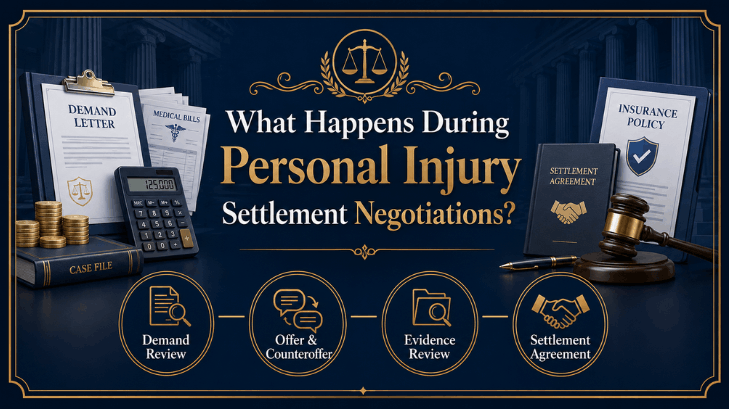
The negotiation process typically formally begins with a demand letter sent to the insurance company. This letter generally outlines:
- A summary of how the accident happened and who was at fault
- A description of your injuries and treatment
- An itemized list of economic damages (medical bills, lost wages, property damage) and non-economic damages (pain and suffering, emotional distress)
- A specific settlement amount being requested, often set somewhat higher than the minimum acceptable figure to leave room for negotiation
- Supporting documentation attached as proof
4. The Insurance Company’s Response
After reviewing the demand, the adjuster typically responds with a counteroffer. It is common, and considered standard industry practice, for this first counteroffer to be noticeably lower than the demand. This does not necessarily mean the claim lacks value; it is often simply an opening position used to test how firm the other side is.
5. Back-and-Forth Counteroffers
From here, negotiations typically continue through a series of offers and counteroffers. Each side may explain its reasoning, citing medical evidence, comparable case outcomes, fault disputes, policy limits, and the factors involved in calculating a fair injury settlement. This stage can move quickly or take weeks to months, depending on the complexity of the injuries and how much the two sides initially disagree.
6. Considering Mediation
If negotiations stall, both sides sometimes agree to mediation, where a neutral third party helps facilitate discussion and explore middle ground. Mediation is voluntary in most situations and is not the same as a trial.
7. Reaching an Agreement (or Not)
If both sides agree on a number, the settlement is typically documented in a written release, which generally ends your right to pursue further compensation related to that incident. If no agreement is reached, the next step is usually filing a lawsuit, which can lead to continued negotiation, formal mediation, or eventually trial.
8. Finalizing and Disbursing the Settlement
Once a settlement is signed, funds are typically sent to the injured person’s attorney (if represented), who is generally responsible for paying any outstanding medical liens, deducting agreed-upon legal fees, and disbursing the remaining balance. If you are not represented by an attorney, you would typically handle this directly with the insurer.
How Insurance Adjusters Evaluate a Claim
Adjusters generally consider economic damages (bills, wages, and other measurable costs) plus an estimate for non-economic damages like pain and suffering. Two methods commonly referenced in the industry include the multiplier method, where total medical bills are multiplied by a factor reflecting injury severity, and the per diem method, which assigns a daily dollar value to pain and suffering. These are general industry approaches, not guarantees of any particular outcome, and actual valuation depends heavily on your specific facts and state law.
Evidence Checklist for Settlement Negotiations
| Document Type | Why It Matters |
|---|---|
| Medical records and bills | Establishes the nature, severity, and cost of your injuries |
| Accident or police report | Documents how the incident occurred and who was involved |
| Photos and video | Visually shows injuries, property damage, or scene conditions |
| Witness statements | Supports your account of what happened |
| Proof of lost wages | Shows income lost due to time away from work |
| Insurance declarations pages | Reveals available coverage limits for the claim |
| Settlement offer history | Tracks prior offers and counteroffers for reference |
Common Mistakes to Avoid During Negotiations
| Mistake | Why It Can Hurt Your Claim |
|---|---|
| Accepting the first offer | Initial offers are often a starting point, not a final number |
| Settling before treatment ends | May not account for ongoing or future medical needs |
| Giving a recorded statement without preparation | Statements can be used to dispute or minimize your claim |
| Posting about the accident on social media | Insurers may review public posts to challenge your claim |
| Missing filing deadlines | Settlement talks do not pause the statute of limitations |
| Failing to document damages thoroughly | Weak documentation can lower your negotiating position |
State-Specific Notes on Timing and Deadlines
Every state sets its own statute of limitations, the legal deadline for filing a personal injury lawsuit. Many states use a two- or three-year window, but some states allow as little as one year, while others allow longer. Ongoing settlement negotiations do not pause or extend this deadline. If a deadline is approaching and a settlement has not been reached, filing a lawsuit may be necessary simply to preserve your legal rights, even while negotiations continue.
Claims against a government agency (such as a city, county, or state entity) often involve separate, much shorter notice requirements, sometimes just months after the incident. Because these rules vary significantly by state and by the type of claim, it is important to confirm the specific deadline that applies to your situation.
When Should You Talk to a Personal Injury Lawyer?
While some straightforward, low-value claims are negotiated directly with an insurer, many people choose to consult an attorney, particularly when:
- Injuries are serious, long-term, or involve permanent impairment
- Liability (who was at fault) is disputed
- The insurance company denies the claim or offers a settlement that seems inconsistent with the documented damages
- Multiple parties or insurance policies are involved
- A filing deadline is approaching and no resolution is in sight
An attorney can help value a claim, handle communications with adjusters, and advise on whether an offer is reasonable given the specifics of your case. Many personal injury attorneys offer free initial consultations.
Practical Next Steps
- Seek medical attention and follow your provider’s recommended treatment plan.
- Keep organized records of medical bills, lost income, and accident-related expenses.
- Avoid giving detailed statements to the other party’s insurer until you understand your claim’s value.
- Note your state’s statute of limitations and any shorter notice deadlines that may apply.
- Consider a consultation with a personal injury attorney, especially for serious injuries or disputed liability.
Settling vs. Going to Trial: What’s the Difference?
Most personal injury cases are resolved through settlement rather than trial. A settlement is a private agreement between the parties, while a trial involves a judge or jury deciding the outcome. Settlements tend to offer more certainty and a faster resolution, while trials carry more risk and unpredictability but, in some cases, may result in a different award than what was offered in negotiations.
Understanding the Settlement Process Helps You Move Forward
Personal injury settlement negotiations rarely happen in a single conversation. They typically unfold through a demand letter, a series of counteroffers, and careful review of medical and financial documentation before both sides agree on a number. Knowing what to expect at each stage, from gathering evidence to evaluating a final offer, can help you approach the process with more confidence and avoid common pitfalls.
If you are currently dealing with an injury claim, take time to organize your documentation and understand the general deadlines that may apply in your state. For guidance specific to your situation, consider speaking with a licensed personal injury attorney or your state bar association’s referral service.
Looking for clear answers to common legal questions? Visit US Legal Journal for practical guides on personal injury, criminal law, family law, business matters, and more.
Frequently Asked Questions
How long do personal injury settlement negotiations usually take?
Timelines vary widely. Straightforward claims with clear liability may resolve in a few weeks to a few months, while complex cases involving serious injuries or disputed fault can take much longer. There is no fixed timeline, and negotiations can continue even after a lawsuit is filed.
Can I negotiate a settlement without a lawyer?
Yes, it is possible to negotiate directly with an insurance adjuster, particularly for minor claims. However, insurance companies have experienced adjusters working to minimize payouts, so many people choose to consult an attorney for more complex or higher-value claims.
Do I have to accept the insurance company’s first offer?
No. You are not required to accept any offer, and the first offer is often just an opening position. You can negotiate, request justification for a low offer, or reject it and continue discussions.
What happens if negotiations fail?
If both sides cannot agree on a settlement amount, the next step is generally filing a lawsuit. Even after a lawsuit is filed, settlement discussions often continue, and many cases still resolve before reaching trial.
Does starting negotiations pause the statute of limitations?
No. Settlement talks do not pause or extend your state’s filing deadline. If a deadline is approaching, you may need to file a lawsuit to protect your rights, even while negotiations are ongoing.
Will my settlement be taxed?
Tax treatment depends on the type of damages and individual circumstances. Many compensatory damages for physical injuries are generally not taxed at the federal level, but exceptions exist. Consult a tax professional or the IRS for guidance specific to your situation.
d term before the court finalizes the divorce. When that happens, the unresolved issue must go through the contested process.
People Also Ask
What is the average personal injury settlement amount?
There is no universal average, since settlement values depend on injury severity, medical costs, lost income, fault, and available insurance coverage. Claims vary dramatically case by case, and any specific figure quoted online should be treated as a general reference point, not a prediction for your claim.
How do insurance companies calculate settlement offers?
Adjusters typically add up economic damages like medical bills and lost wages, then apply an estimate for non-economic damages such as pain and suffering. Methods like multiplying medical costs by a severity factor are common industry tools, but the actual figure used can vary by insurer and case.
Why is the insurance company’s first offer so low?
Insurers often start with a deliberately low offer to gauge whether a claimant understands their case’s value or will accept quickly. This is a common negotiating tactic across the industry rather than a final assessment of your claim.
Can a settlement offer be withdrawn after it’s made?
In many cases, an offer can be withdrawn before it is formally accepted, similar to other contract negotiations. Once both sides agree in writing, the settlement generally becomes binding, which is why reviewing terms carefully before accepting matters.
Is mediation required in a personal injury case?
Mediation is not automatically required in most personal injury cases, though some courts may order it, or both sides may choose it voluntarily, to help resolve a stalled negotiation before proceeding toward trial.
This article is for general informational purposes only and does not provide legal advice. Laws and procedures may vary by state, city, court, agency, or individual situation. For advice about your specific legal issue, speak with a qualified attorney or the appropriate government agency.