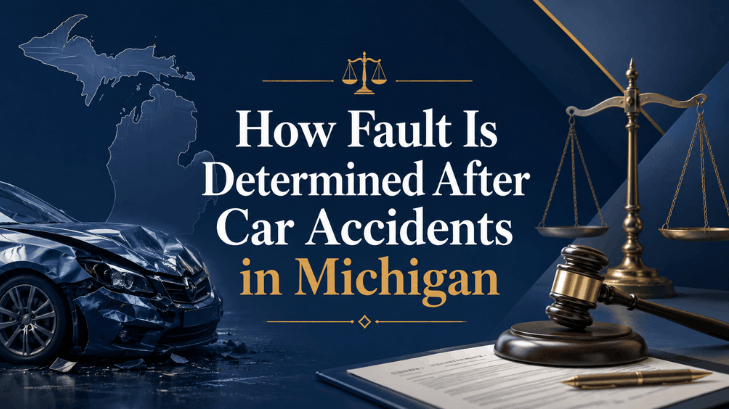
After a crash, one of the first questions most drivers ask is simple: who was at fault? In Michigan, the answer matters more than in many other states because of the state’s unique no-fault insurance system. Understanding how fault is determined after car accidents in Michigan can help you know what to expect, what evidence to gather, and how the process affects your ability to recover compensation.
Michigan’s rules are different from most of the country. Even though the state runs on a no-fault insurance model, fault still plays a major role in certain parts of an accident claim — particularly vehicle damage and pain-and-suffering lawsuits. This guide breaks down how investigators, insurers, and courts decide who caused a crash, and what that determination means for your claim.
This article is for general informational purposes only and is not a substitute for advice from a licensed Michigan attorney.
Quick Answer
In Michigan, fault after a car accident is determined by reviewing police reports, driver and witness statements, traffic law violations, vehicle damage patterns, video footage, and sometimes “black box” data from the vehicle’s event data recorder. A driver may be found at fault if they violated a traffic law, failed to drive with reasonable care, or otherwise caused the crash through negligence. Fault does not affect your ability to collect your own no-fault medical and wage-loss benefits, but it does affect vehicle damage claims and lawsuits for pain and suffering.
Quick Summary
- Michigan is a no-fault insurance state, so your own insurer pays your medical bills and lost wages after a crash regardless of who caused it.
- Fault still matters for vehicle damage claims and for lawsuits seeking pain and suffering compensation.
- Police reports, physical evidence, witness statements, and vehicle data are the main tools used to establish fault.
- Rear-end collisions carry a legal presumption of fault against the driver who struck the other vehicle.
- To sue an at-fault driver for pain and suffering, you generally must show your injury meets Michigan’s “serious impairment of body function” threshold.
- Laws and outcomes vary by situation, so speaking with a Michigan attorney can help clarify your specific rights.
Understanding Michigan’s No-Fault System
Michigan requires every driver to carry no-fault auto insurance. Under this system, your own insurance company pays for your Personal Injury Protection (PIP) benefits — including medical treatment, a portion of lost wages, and replacement services — after a crash, regardless of who caused it. This structure was designed to get injured drivers medical care and financial support quickly, without waiting for a fault investigation to conclude.
Because of this, many people assume fault doesn’t matter in Michigan. That’s only partly true. Fault becomes important in two specific situations:
- Vehicle damage claims. Michigan’s no-fault law does not require an insurer to pay for damage to your own vehicle unless you carry collision coverage. Under the state’s “mini-tort” law, you may be able to recover a limited amount from the at-fault driver for vehicle damage not otherwise covered.
- Pain and suffering lawsuits. If you were injured and meet Michigan’s injury threshold, you may be able to sue the at-fault driver for pain and suffering and for economic losses beyond what PIP covers.
If you’re trying to understand how the money side of a claim works once fault is established, our guide on personal injury settlements calculation after an accident walks through the factors insurers and attorneys typically weigh.
Who Investigates Fault After a Crash?
Fault isn’t decided by a single person or agency. It usually develops through several overlapping processes:
Police Officers at the Scene
When officers respond to a crash, they typically speak with each driver, review vehicle positions and damage, and note any visible traffic violations. Their observations go into the official police crash report, which is often one of the first documents insurers review.
Insurance Adjusters
Each driver’s insurance company conducts its own fault investigation, even though PIP benefits are paid without regard to fault. Adjusters review the police report, photos, repair estimates, and statements to decide how they will handle the mini-tort or liability portion of a claim.
Accident Reconstruction Experts
In serious or disputed crashes, an accident reconstruction specialist may analyze skid marks, vehicle damage, road conditions, and event data recorder (“black box”) information to recreate how the collision happened.
Courts
If a case goes to litigation, a judge or jury may ultimately decide fault based on the evidence presented, applying Michigan’s negligence standards.
What Evidence Is Used to Establish Fault?
Several types of evidence commonly come into play:
- Police crash reports and citation records
- Statements from drivers, passengers, and independent witnesses
- Photos and videos from the scene, dashcams, or nearby surveillance cameras
- Vehicle damage patterns and point of impact
- Event data recorder (“black box”) information showing speed, braking, and other data just before the crash
- Traffic signal timing or road design records, when relevant
- Cell phone records, in cases involving suspected distracted driving
For a deeper look at how this evidence is gathered and used, see our related article on evidence that proves fault after a car accident.
Legal Standards Used to Determine Fault in Michigan
Michigan applies ordinary negligence principles to car accidents. Generally, a driver may be considered at fault if they:
- Violated a state or local traffic law (such as speeding, running a red light, or failing to yield)
- Failed to use the level of care a reasonably careful driver would use under similar conditions
- Directly caused the crash through their driving behavior
Common driving behaviors that frequently factor into fault determinations include speeding, distracted driving (such as texting), driving too fast for road or weather conditions, drowsy driving, disregarding traffic signs or signals, and impaired driving.
The Rear-End Collision Presumption
Michigan law includes a specific rule for rear-end crashes. A driver who rear-ends another vehicle is generally presumed to be at fault under MCL 257.402(a), which treats the rear driver as “prima facie” negligent. This presumption can sometimes be challenged with evidence — for example, if the lead vehicle stopped abruptly without cause or reversed unexpectedly — but the burden typically falls on the rear driver to rebut it.
Comparative Fault
Michigan follows a modified comparative fault framework in third-party injury lawsuits. This means more than one driver can share responsibility for a crash, and a person’s own percentage of fault can reduce the compensation they’re eligible to recover. How comparative fault is applied depends heavily on the specific facts of the case, which is why it’s often discussed directly with an attorney rather than assumed from general guidance.
How Fault Affects Different Parts of Your Claim
| Claim Type | Does Fault Matter? | What Typically Happens |
| PIP medical and wage-loss benefits | No | Paid by your own insurer regardless of who caused the crash |
| Vehicle damage (no collision coverage) | Yes | Mini-tort law allows limited recovery from the at-fault driver |
| Vehicle damage (with collision coverage) | Partially | Your insurer may pay first, then seek reimbursement from the at-fault party’s insurer |
| Pain and suffering lawsuit | Yes | Requires proving the other driver was at fault and that your injury meets the legal threshold |
| Excess economic damages beyond PIP limits | Yes | May be pursued against the at-fault driver in a third-party claim |
Common Scenarios Where Fault Gets Disputed
- Intersection collisions where both drivers claim they had the right of way
- Merging or lane-change accidents where it’s unclear who failed to check their blind spot
- Multi-vehicle pileups, where several drivers may share partial responsibility
- Left-turn accidents, where the turning driver is often — but not always — presumed at fault
- Weather-related crashes, where questions arise about whether a driver adjusted their speed appropriately for conditions
These disputes are a major reason insurers and courts rely so heavily on documented evidence rather than driver accounts alone.
Mistakes That Can Weaken a Fault Determination in Your Favor
- Failing to call the police or get an official crash report
- Not photographing the scene, vehicle damage, or road conditions before vehicles are moved
- Giving a recorded statement to an insurance adjuster before understanding how it may be used
- Missing the deadline to file for no-fault benefits
- Assuming fault doesn’t matter simply because Michigan is a no-fault state
- Not seeking prompt medical evaluation, which can create gaps that adjusters later question
Timelines That Can Affect a Michigan Car Accident Claim
Michigan law sets specific deadlines connected to auto accident claims. Generally, injured drivers must submit a written notice or application for no-fault PIP benefits within one year of the crash, and lawsuits against an at-fault driver for pain and suffering typically must be filed within three years of the crash. These timeframes can vary depending on the circumstances, including cases involving minors or government vehicles, so it’s important to confirm current deadlines with an attorney rather than relying solely on general information.
When to Speak With a Michigan Car Accident Attorney
You are not required to hire a lawyer after a Michigan car accident, and many minor claims are resolved without one. However, it may be worth consulting an attorney if:
- Fault is disputed or unclear
- Your injuries are serious or long-term
- An insurance company is denying or delaying your PIP benefits
- You’re unsure whether your injuries meet the “serious impairment of body function” threshold
- Multiple vehicles or parties are involved
If you’re trying to understand what happens once you’ve decided to pursue a claim, our article on personal injury settlement negotiations outlines the general process.
Take the first step toward understanding your legal situation. Visit US Legal Journal for clear information about your rights, options, and possible next actions.
People Also Ask
Does fault matter if Michigan is a no-fault state?
Yes, in specific ways. Fault doesn’t affect your own PIP medical and wage-loss benefits, which are paid regardless of who caused the crash. However, fault still matters for vehicle damage claims under the mini-tort law and for lawsuits seeking pain and suffering compensation from the at-fault driver.
Who decides fault in a Michigan car accident?
No single party makes a final, binding fault determination in most cases. Police officers document the scene, insurance adjusters investigate for claims purposes, and courts make the final legal determination if a case is litigated. These findings can sometimes differ from one another.
Is the rear driver always at fault in a rear-end crash?
Not always, but Michigan law presumes the rear driver is at fault under MCL 257.402(a). This presumption can potentially be challenged with evidence showing the lead driver acted unreasonably, such as stopping abruptly without cause.
Can two drivers share fault in Michigan?
Yes. Michigan follows a modified comparative fault approach, meaning more than one driver can be found partially responsible. A person’s own percentage of fault can affect how much compensation they’re eligible to recover in a third-party claim.
What if the police report says I was at fault but I disagree?
A police report is an important piece of evidence, but it’s not always the final word. You can gather additional evidence, such as photos, witness statements, or video, and discuss disputing the report’s conclusions with an attorney. generally require written notice within six months, and claims against counties generally require notice within twelve months. These deadlines are separate from, and often shorter than, the standard two-year statute of limitations.
Frequently Asked Questions
Do I need a police report to prove fault in Michigan?
A police report isn’t always legally required, but it’s one of the most influential pieces of evidence in a fault dispute. Without one, you may need to rely more heavily on photos, witness accounts, and other documentation to support your version of events.
Can I still get no-fault benefits if I caused the accident?
In most cases, yes. Michigan’s no-fault system generally pays PIP benefits regardless of fault, with limited exceptions such as certain instances of intentional misconduct or specific statutory exclusions. An attorney can review whether any exclusions apply to your situation.
How long do I have to file a claim after a Michigan car accident?
Deadlines vary depending on the type of claim, such as no-fault benefits versus a lawsuit against an at-fault driver. Because these timeframes are strict and can vary by circumstance, it’s best to confirm current deadlines with an attorney or the relevant insurer as soon as possible after a crash.
Does a traffic ticket automatically mean I was at fault?
A citation can support a fault finding, but it isn’t automatically the same as a legal determination of fault in a civil claim. Insurers and courts typically weigh it alongside other evidence rather than treating it as conclusive on its own.
Can fault change after the initial police report is filed?
Yes. New evidence — such as video footage, witness statements, or expert analysis — can shift how fault is viewed as a claim develops. This is part of why documentation and follow-up matter even after the initial report is filed.
Legal Disclaimer
This article is for general informational purposes only and does not provide legal advice. Laws and procedures may vary by state, city, court, agency, or individual situation. For advice about your specific legal issue, speak with a qualified attorney or the appropriate government agency.