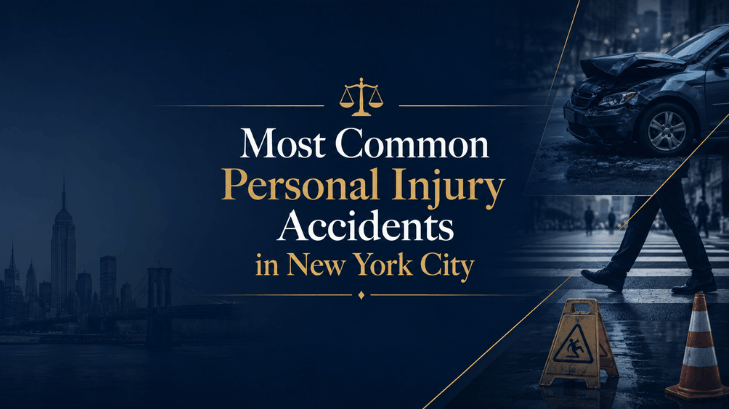
Walk down any block in Manhattan, Brooklyn, or Queens during rush hour, and it’s easy to see why New York City sees so many personal injury accidents every year. Crowded sidewalks, heavy traffic, aging buildings, and constant construction all add up to real risk for pedestrians, drivers, cyclists, and workers alike.
If you or someone you know has been hurt in an accident in NYC, understanding what type of accident occurred, and how these cases typically work, can help you make informed decisions about your next steps. This guide breaks down the most common personal injury accidents in New York City, what causes them, and the general legal process that often follows.
This article does not replace advice from a licensed attorney. Every case is different, and the information below is meant to help you understand the basics before you speak with a legal professional.
Quick Answer
The most common personal injury accidents in New York City involve motor vehicle collisions, pedestrian crashes, bicycle and e-bike incidents, slip and fall accidents, and construction site injuries. Traffic-related accidents remain a leading cause of injury citywide, while premises liability and workplace accidents are also frequently reported. Legal options depend on where the accident happened, who was involved, and how the injury occurred, so the right next step usually depends on the specific facts of the case.
Quick Summary
- Uber’s insurance coverage changes depending on the driver’s “app status” at the time of the accident.
- Uber generally provides up to $1 million in liability coverage once a ride is accepted through drop-off (Periods 2 and 3).
- When the app is completely off, only the driver’s personal auto insurance typically applies.
- Passengers injured while riding in an Uber may have a claim even if they were not at fault for the crash.
- Fault still matters — the at-fault driver’s insurance is usually responsible for damages first.
- Insurance requirements, deadlines, and coverage amounts vary by state, so it’s important to confirm the rules where the accident happened.
- Traffic-related incidents, including car, pedestrian, and bicycle crashes, remain among the most frequently reported personal injury accidents in New York City.
- Slip and fall accidents and construction site injuries are also common, especially in a city with dense sidewalks, aging infrastructure, and constant building activity.
- New York follows a pure comparative negligence rule, meaning an injured person may still recover damages even if they were partly at fault.
- New York is a no-fault auto insurance state, which affects how car accident injury claims are typically handled.
- Claims involving a city agency, like the MTA or NYC Department of Transportation, usually require a Notice of Claim within a short deadline, often 90 days.
- Laws, deadlines, and procedures vary by situation, so speaking with a licensed New York attorney is the only way to get advice specific to your case.
Why Personal Injury Accidents Are So Common in New York City
New York City is one of the most densely populated cities in the country, and that density shapes almost every type of accident that happens here. Millions of pedestrians share the same streets with cars, trucks, bicycles, e-bikes, and buses every day. Add in narrow sidewalks, older buildings, ongoing construction projects, and a transit system used by millions of daily riders, and the opportunities for accidents multiply.
City agencies such as the NYC Department of Transportation track this data closely through programs like Vision Zero, which aims to reduce traffic deaths and injuries citywide. While the city has made measurable safety improvements in recent years, personal injury accidents still happen every day across all five boroughs.
1. Car and Motor Vehicle Accidents
Motor vehicle collisions remain one of the most frequently reported causes of personal injury in New York City. These accidents can involve private cars, taxis, rideshare vehicles, delivery trucks, or city buses.
Common contributing factors reported by city traffic data include distracted driving, failure to yield, speeding, and driving under the influence. Because New York is a no-fault insurance state, an injured driver or passenger typically files a claim with their own auto insurance first, regardless of who caused the crash. A lawsuit against the at-fault driver is generally only possible if the injury meets New York’s legal definition of a ‘serious injury’ under the state’s Insurance Law.
Because faults can be disputed, documentation matters. Learn more about the evidence that proves fault after a car accident, including police reports, photos, and witness statements that are commonly used to support a claim.
2. Pedestrian Accidents
Pedestrians face some of the highest risks on New York City streets, since they have no physical protection in a collision with a vehicle. City transportation data consistently shows pedestrians make up a large share of traffic-related injuries and fatalities each year, even as overall numbers have trended downward under safety initiatives like Vision Zero.
Many pedestrian accidents happen at intersections, often involving a turning vehicle that fails to yield to someone in a crosswalk. Poor visibility, distracted driving, and speeding are frequently cited contributing factors. Seniors and children are often especially vulnerable in these types of accidents.
3. Bicycle and E-Bike Accidents
The rise of cycling and e-bike use across New York City, especially among delivery workers, has brought a corresponding rise in bicycle-related injury accidents. Cyclists face risks from vehicle doors opening into bike lanes, drivers turning without checking for bikes, and roadway hazards.
E-bike and delivery-related accidents raise unique legal questions, since a delivery worker’s employer or the app-based platform they work for may play a role in liability, depending on the circumstances. These cases can be more complex than a typical two-vehicle crash.
4. Slip, Trip, and Fall Accidents
Slip and fall accidents are a leading category of premises liability claims in New York City. Cracked sidewalks, icy stairs, wet floors, uneven flooring, and poor lighting in stairwells or hallways are common causes.
Property owners and managers generally have a legal duty to keep their premises reasonably safe. Whether a claim is against a private landlord, a business, or the city itself, often depends on where the fall happened. Sidewalk defects, for example, can involve responsibility split between an adjacent property owner and the city, depending on the type of defect and local law.
5. Construction Site Accidents
With constant building activity across the five boroughs, construction accidents are a significant source of serious personal injury in New York City. Falls from heights, scaffolding collapses, falling debris, and equipment malfunctions are among the most frequently reported incidents.
New York’s Labor Law includes specific protections for construction workers, commonly referred to as the Scaffold Law, which can create liability for property owners and contractors in certain fall-related accidents. Workers injured on the job may also be eligible for workers’ compensation benefits through the New York State Workers’ Compensation Board, separate from any third-party injury claim.
6. Subway, Bus, and Rideshare Accidents
Millions of New Yorkers rely on public transit every day, and accidents involving the subway, city buses, or rideshare vehicles are common enough to warrant their own category. These can include platform accidents, injuries from sudden stops, doors closing on a passenger, or collisions involving a bus or rideshare vehicle.
Claims involving the MTA or NYC Transit generally require a Notice of Claim to be filed within a short window, often 90 days from the incident. This is a strict procedural requirement, and missing it can seriously limit a person’s legal options.
Legal Rights After an Accident in New York City
New York follows a pure comparative negligence rule. This means an injured person can still recover compensation even if they were partly responsible for the accident, though their recovery may be reduced by their percentage of fault. This differs from states that bar recovery entirely once a person is found more than 50% at fault.
For car accidents specifically, New York’s no-fault insurance system means medical bills and lost wages are typically covered through a person’s own auto policy up to a certain amount, regardless of fault. A separate injury lawsuit against the at-fault party generally requires meeting the state’s serious injury threshold.
If a claim moves toward resolution, understanding personal injury settlements calculations can help set realistic expectations about medical expenses, lost income, and other damages that are typically considered.
Evidence and Documents That Matter
Regardless of the type of accident, certain records tend to matter across almost every personal injury claim in New York City:
- Police or incident reports filed at the scene
- Photos or video of the accident location and any visible injuries
- Contact information for witnesses
- Medical records and bills related to treatment
- Proof of lost wages or missed work
- Any correspondence with insurance companies
Keeping these records organized early on can make it easier to understand the full scope of an injury and support a claim later, if one is pursued.
Deadlines You Should Know
Deadlines for filing a personal injury claim in New York vary significantly depending on who is involved. The table below outlines general timeframes, but exact deadlines depend on the specific facts of a case and should be confirmed with an attorney or the relevant agency.
| Situation | General Timeframe | Notes |
|---|---|---|
| Personal injury claim against a private person or business | Generally 3 years from the date of the accident | Set by CPLR 214; exceptions can apply, so confirm timing with an attorney |
| Claim involving New York City or a city agency | Notice of Claim generally within 90 days; lawsuit generally within 1 year and 90 days | Governed by General Municipal Law; missing the notice deadline can bar the claim |
| Claim involving the MTA, NYC Transit, or a city bus/subway accident | Notice of Claim requirements similar to city claims, often 90 days | MTA entities have their own notice procedures; confirm the correct agency |
| Workers’ compensation claim after a workplace injury | Employer notification is generally recommended promptly; formal claim deadlines apply | Handled through the NYS Workers’ Compensation Board, separate from a lawsuit |
| Wrongful death claim | Generally 2 years from the date of death | Set by New York’s wrongful death statute; timing can be complex |
Accident Type vs. Typical Claim Path
The table below offers a general overview of how different types of NYC accidents are typically handled. This is not a substitute for legal advice, since the right path depends on the specific facts involved.
| Accident Type | Typical Legal Path | Who May Be Responsible |
|---|---|---|
| Car or taxi accident | No-fault insurance claim first; injury lawsuit possible if the injury meets the ‘serious injury’ threshold | Driver, vehicle owner, sometimes a city agency for road defects |
| Pedestrian accident | Personal injury claim against the driver’s insurance; possible claim against the city for a dangerous roadway design | Driver, and in some cases NYC DOT |
| Bicycle or e-bike accident | Personal injury claim against the at-fault driver or, in delivery-related cases, an employer | Driver, delivery company, or vehicle owner |
| Slip and fall | Premises liability claim against the property owner or manager | Building owner, landlord, business, or the city if it’s a public sidewalk defect |
| Construction accident | Workers’ compensation claim, and possibly a third-party Labor Law claim | Employer, general contractor, property owner, or equipment manufacturer |
| Subway or bus accident | Notice of Claim against the MTA or NYC Transit, then a personal injury claim | MTA, NYC Transit, or a private bus operator |
Mistakes to Avoid After an Accident
- Waiting too long to seek medical attention, even if injuries seem minor at first
- Not reporting the accident to the appropriate authority, property owner, or employer
- Giving a recorded statement to an insurance company before understanding your rights
- Missing a Notice of Claim deadline when a city agency or public entity is involved
- Posting details about the accident or injuries on social media
- Assuming a claim isn’t worth pursuing without speaking to an attorney first
When to Speak With a Personal Injury Attorney
Not every minor incident requires legal representation, but certain situations generally call for speaking with an attorney sooner rather than later. These include accidents involving serious injury, a dispute over who was at fault, a claim involving a city agency or public transit system, or a workplace construction accident. An attorney can also help explain how comparative negligence, insurance coverage, or a Notice of Claim deadline may apply to a specific situation.
If settlement talks begin, it also helps to understand the personal injury settlement negotiation process, which often involves back-and-forth discussions before a resolution is reached.
Practical Next Steps After an Accident
- Seek medical care and follow through with any recommended treatment
- Report the accident to the appropriate party, such as police, a property owner, an employer, or a transit agency
- Document the scene, injuries, and any relevant conditions with photos
- Keep copies of all medical bills, records, and correspondence
- Avoid signing insurance documents or accepting a settlement offer without understanding your options
- Consult a licensed New York attorney to discuss the specific facts of your situation
Injured in a Common NYC Accident? Get Legal Help Today
Personal injury accidents in New York City happen in many forms, from car and pedestrian crashes to slip and falls and construction site injuries. Understanding the type of accident involved, the deadlines that may apply, and the general legal process can help you feel more prepared if you or someone you know is ever affected.
Because laws and procedures vary depending on the accident, the parties involved, and the specific city or state agency in question, this article should be treated as a starting point rather than a final answer. If you’ve been injured in New York City, consider speaking with a qualified New York attorney or the appropriate government agency to understand your specific options.
Know Your Rights. Explore Your Legal Options. Take the Next Step.
Get clear, easy-to-understand information about your legal rights, available options, and possible next steps with the US Legal Journal. Explore informative legal resources covering a wide range of topics for individuals, families, and businesses across the United States.
People Also Ask
What is the most common type of personal injury accident in NYC?
Traffic-related accidents, including car, pedestrian, and bicycle crashes, are among the most frequently reported personal injury accidents in New York City. Slip and fall incidents and construction site injuries are also common, particularly given the city’s dense sidewalks and ongoing building activity across the five boroughs.
Can I still recover compensation if I was partly at fault for an accident in New York?
Possibly. New York follows a pure comparative negligence rule, which generally allows an injured person to recover compensation even if they share some responsibility for the accident. Any recovery may be reduced based on the percentage of fault assigned, so the specific facts of the accident matter.
Do I need to file a special notice if my accident involved the MTA or NYC Transit?
Generally, yes. Claims involving the MTA, NYC Transit, or other city agencies typically require a Notice of Claim to be filed within a short deadline, often around 90 days from the incident. Missing this deadline can significantly limit legal options, so prompt action is important.
Who is responsible for a slip and fall on a NYC sidewalk?
Responsibility can fall on the adjacent property owner, a business, or the city itself, depending on the type of defect and applicable local law. Sidewalk liability rules in New York City can be complex, which is why the specific location and cause of the fall matter.
How long do I have to file a personal injury lawsuit in New York?
For most personal injury claims against a private party, New York generally allows 3 years from the date of the accident under CPLR 214. Claims involving a government entity have much shorter notice requirements, so it’s important to confirm the applicable deadline for your specific situation.
Frequently Asked Questions
Is New York a no-fault state for car accidents?
Yes. New York requires drivers to carry no-fault insurance, which generally covers medical expenses and lost wages after a car accident regardless of who caused the crash, up to policy limits. A separate lawsuit against the at-fault driver is typically only available if the injury meets the state’s serious injury threshold.
What should I do immediately after a construction accident in NYC?
Report the incident to a supervisor as soon as possible, seek medical attention, and document the scene if it’s safe to do so. Workers’ compensation claims generally have their own reporting requirements, separate from any additional legal claim, so prompt reporting matters.
Can I file a claim for an e-bike or delivery accident?
It depends on the circumstances. Liability may involve the rider, a vehicle driver, or in some cases an employer or delivery platform, depending on how the accident happened. These cases can involve more complex questions than a typical two-vehicle crash.
Does New York City have a program to reduce traffic accidents?
Yes. New York City runs a traffic safety initiative called Vision Zero, which focuses on street design, enforcement, and public education aimed at reducing traffic deaths and serious injuries citywide. The city’s Department of Transportation publishes data on these efforts.
Will hiring a lawyer guarantee a settlement or a specific compensation amount?
No. No attorney can guarantee a particular outcome, settlement amount, or approval of any claim. Every case depends on its own facts, evidence, and applicable law, and outcomes can vary significantly from one situation to another.
Legal Disclaimer
This article is for general informational purposes only and does not provide legal advice. Laws and procedures may vary by state, city, court, agency, or individual situation. For advice about your specific legal issue, speak with a qualified attorney or the appropriate government agency.