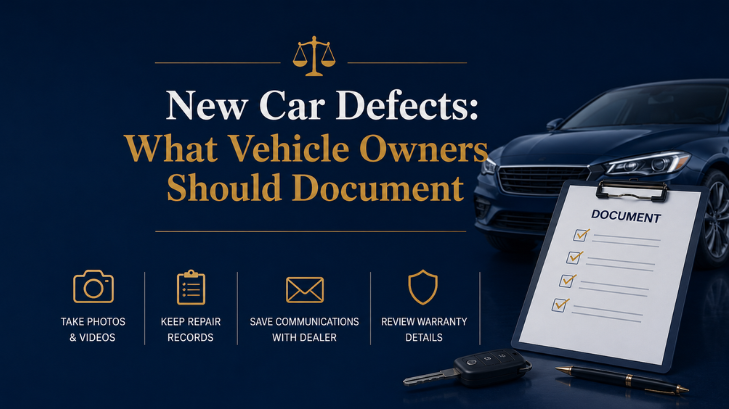
Buying a new car is supposed to come with peace of mind, not a string of trips back to the dealership. When new car defects show up soon after purchase — a stalling engine, a transmission that slips, or electronics that fail without warning — owners often don’t know what they’re supposed to keep track of, or whether their situation even qualifies for help under the law.
This matters because lemon law and vehicle warranty claims are built almost entirely on paper trails. A defect that isn’t documented is much harder to prove later, even if it was real and recurring. Knowing what to record from the very first repair visit can make a meaningful difference if a vehicle owner later decides to pursue a claim.
This article explains, in plain language, what new car defects typically look like, what vehicle defects lemon law cases generally require, and what documentation owners should start gathering right away. It is general information only — not a substitute for advice from a licensed attorney or your state’s consumer protection agency.
Quick Answer
If your new car has a recurring defect, keep every repair order, invoice, and written communication with the dealer or manufacturer, and write down the date, mileage, and symptoms each time the problem occurs. Most state lemon laws and the federal Magnuson-Moss Warranty Act require proof that the manufacturer had a reasonable number of chances to fix the defect during the warranty period. Strong documentation — not memory — is usually what determines whether a vehicle defects lemon law claim can move forward. Rules vary by state, so check your state’s specific lemon law requirements or speak with an attorney.
Quick Summary
- New car defects that affect safety, value, or use may qualify for relief under state lemon laws or the federal Magnuson-Moss Warranty Act, but the exact rules vary by state.
- Owners should document every repair visit, including the date, mileage, described symptoms, technician notes, and how long the vehicle was out of service.
- Most states require the manufacturer to be given a reasonable number of repair attempts (often three or four) or a set number of days out of service before a claim can proceed.
- Keep all paperwork: purchase or lease agreement, warranty booklet, repair orders, invoices, emails, text messages, and any NHTSA complaint or recall notice related to the vehicle.
- Lemon law claims generally must be filed within a specific time window after purchase or during the warranty period — missing this window can affect eligibility.
- This article does not guarantee any outcome. Speak with a qualified attorney or your state attorney general’s office about your specific situation.
What Counts as a New Car Defect?
A new car defect is generally a mechanical, electrical, or safety-related problem that appears in a vehicle while it is still covered by the manufacturer’s warranty. Not every issue qualifies as a “lemon.” Most state lemon laws focus on defects that substantially impair the vehicle’s use, value, or safety — language that traces back to consumer warranty statutes such as California’s Song-Beverly Consumer Warranty Act and is echoed in many other states.
Minor cosmetic issues, such as a small paint blemish that doesn’t affect performance, typically do not meet this standard on their own. However, persistent and unresolved issues often do. Examples vehicle owners commonly report include:
- Engine stalling, hesitation, or unexpected shutdowns
- Transmission slipping, jerking, or failing to shift properly
- Brake or steering problems that raise safety concerns
- Electrical system failures, including dashboard warning lights that won’t clear
- Persistent fluid leaks (oil, coolant, transmission fluid)
- Software or infotainment system failures that recur after updates or repairs
Whether a specific defect meets your state’s legal threshold is a fact-specific question. Many state lemon law programs and consumer protection offices publish guidance on what qualifies, and an attorney can help evaluate a specific vehicle history.
Who Is Affected by New Car Defects?
New car defects can affect anyone who purchases or leases a new vehicle, though documentation needs can differ slightly depending on the situation:
- Buyers who purchased a new vehicle directly from a dealership
- Lessees who are leasing a new vehicle under a manufacturer-backed warranty
- In some states, buyers of certified pre-owned vehicles with remaining manufacturer warranty coverage
Coverage for used and certified pre-owned vehicles varies significantly by state. Some state lemon laws apply only to new vehicles, while others provide limited protection when a used vehicle remains covered by the original manufacturer’s warranty. Understanding used vehicle lemon law coverage can help buyers determine whether their car may qualify, what warranty requirements apply, and which deadlines or repair conditions must be met. Because eligibility rules differ widely, vehicle owners should always confirm the specific scope of protection available under their state’s lemon law.
Legal Background: State Lemon Laws and the Federal Warranty Law
Two layers of law generally apply to new car defects in the United States:
State lemon laws: Every state has its own lemon law statute that sets specific standards for new vehicles, including how many repair attempts or days out of service trigger eligibility, what remedies are available (such as a refund or replacement), and the deadline for filing a claim. These thresholds differ from state to state, so it is important to review your specific state’s statute or speak with a local attorney.
The Magnuson-Moss Warranty Act (federal law): This federal statute governs written warranties on consumer products, including motor vehicles. It does not replace state lemon laws, but it can provide an additional path for owners whose vehicle doesn’t squarely fit state lemon law requirements, as long as a written warranty exists and the manufacturer has not honored it after a reasonable opportunity to repair. More information is available from the Federal Trade Commission (FTC), which enforces this law.
Because these laws vary by state and depend on the specific facts of each case, this article cannot tell you whether a particular vehicle qualifies. A consumer protection attorney or your state’s lemon law program can review your documentation and explain your options.
Evidence and Documents Vehicle Owners Should Keep
Documentation is often the single most important factor in a vehicle defects lemon law claim. Repair shops and manufacturers rely on written records, and so do courts and arbitration panels. Start a dedicated folder (physical or digital) as soon as a defect appears, and keep it updated after every visit.
Documents to Collect
- Purchase agreement or lease contract, including the purchase date and odometer reading at delivery
- Manufacturer’s written warranty booklet or warranty terms
- Every repair order and invoice, even for visits that seemed minor
- Loaner or rental car paperwork showing days the vehicle was out of service
- All written communication with the dealer or manufacturer, including emails, letters, and text messages
- Photos or videos of the defect when it is visible or reproducible (such as warning lights or fluid leaks)
- Any NHTSA complaint filed about the vehicle, and any related recall or technical service bulletin
- A personal log noting the date, mileage, symptoms, and conditions each time the issue occurs
What to Write Down at Each Repair Visit
- The exact date and mileage when the problem occurred
- A clear description of the symptom in your own words (what you saw, heard, felt, or smelled)
- Conditions when it happened (cold start, highway speed, after rain, etc.)
- The name of the dealership or repair facility and the service advisor
- What the technician said was wrong and what repair was performed
- Whether the problem was resolved, partially resolved, or unresolved after the repair
Owners sometimes assume the dealership’s repair order will capture everything needed. In practice, repair orders can be brief or incomplete. A personal log filled out consistently, alongside the official paperwork, often fills in gaps that matter later.
Timelines and Repair Attempt Thresholds
Most state lemon laws require manufacturers to receive a reasonable opportunity to repair a qualifying defect before a vehicle can legally be considered a lemon. Common requirements, although they vary by state, may include a specific number of repair attempts for the same recurring problem or a cumulative number of days the vehicle remains out of service within a defined period after purchase or during the warranty term. Because filing windows and eligibility periods can be strict, understanding important lemon law deadlines may help vehicle owners preserve their rights and avoid missing the time limit for bringing a claim.
The exact numbers, definitions, and filing deadlines differ from state to state, and some states apply different rules depending on whether the defect is safety-related. Because of this variation, this article does not state specific day counts or attempt numbers as a general rule. Vehicle owners should check their state’s lemon law statute directly, consult their state attorney general’s consumer protection division, or speak with a lemon law attorney to confirm the requirements that apply to their situation.
Common Mistakes Vehicle Owners Make
- Waiting too long after a defect appears to start keeping records
- Relying only on memory instead of writing down dates and details
- Losing or discarding repair orders, especially for visits that seemed unrelated
- Communicating only by phone, with no written follow-up confirming what was discussed
- Not checking whether the same defect has triggered a recall or technical service bulletin
- Assuming a single repair attempt automatically disqualifies a claim, or assuming one attempt is automatically enough — both depend on state-specific rules
- Missing the filing deadline because they didn’t confirm their state’s specific statute of limitations
When to Speak with an Attorney
It is generally a good idea to speak with a consumer protection or lemon law attorney once a defect has required more than one repair visit, especially if the issue affects safety, recurs after repair, or has caused the vehicle to be out of service for an extended period. Many lemon law attorneys offer free initial consultations and, depending on the case and applicable law, may not require upfront fees because of fee-shifting provisions in some state and federal statutes.
An attorney can review your specific documentation, explain which laws may apply in your state, and advise you on realistic next steps. This article cannot evaluate individual cases or predict outcomes.
Practical Next Steps for Vehicle Owners
- Start (or update) a defect log today, even if the issue seems minor.
- Request copies of every repair order from the dealership if you don’t already have them.
- Check NHTSA.gov for any open recalls or complaints involving your vehicle’s make, model, and year.
- Review your state’s lemon law statute or contact your state attorney general’s consumer protection office.
- Put future communications with the dealer or manufacturer in writing when possible.
- Consult a qualified attorney before assuming you do or do not have a valid claim.
Evidence Checklist for New Car Defects
| Category | What to Keep | Why It Matters |
| Purchase records | Sales contract, lease agreement, finance documents | Establishes purchase date, price, and odometer reading at delivery |
| Warranty terms | Warranty booklet or digital warranty disclosure | Shows what is covered and the length of coverage |
| Repair history | Every repair order and invoice, even for small issues | Documents repair attempts and what technicians found |
| Personal defect log | Dates, mileage, symptoms, and conditions for each occurrence | Fills gaps that repair orders may not capture |
| Communication | Emails, letters, texts with dealer or manufacturer | Creates a written record of what was reported and promised |
| Time out of service | Loaner/rental agreements, drop-off and pickup dates | Supports claims based on cumulative days out of service |
| Government records | NHTSA complaints, recalls, technical service bulletins | Shows whether the defect is known or already under review |
Document Every Defect Before You Talk to an Attorney
New car defects can be stressful, especially when repeated trips to the dealership don’t resolve the underlying problem. Whether a vehicle ultimately qualifies under your state’s lemon law or the federal Magnuson-Moss Warranty Act depends on specific facts: the type of defect, the number of repair attempts, the time the vehicle has been out of service, and the documentation available to support the claim.
The most useful thing a vehicle owner can do is start documenting now — every repair order, every conversation, every date and mileage reading. Good records won’t guarantee a particular outcome, but they give you and any attorney you consult the clearest possible picture of what has happened. If your new car keeps going back to the shop for the same vehicle defects, lemon law protections may be worth exploring with a qualified professional in your state.
Explore the latest legal guides and practical resources from the US Legal Journal to better understand your rights and available options.
Frequently Asked Questions
Can I get a refund or replacement for a defective new car?
Some state lemon laws allow for a refund, replacement, or cash settlement if a vehicle meets the legal definition of a lemon. Eligibility and the specific remedy available depend on your state’s statute and the facts of your case. This is not guaranteed in every situation.
What if the dealership says the defect is normal?
Document the conversation and continue tracking the issue. A dealership’s opinion about whether something is “normal” is not the same as a legal determination. If the problem persists, your written records will help an attorney or arbitrator evaluate the issue independently.
Does a recall affect my lemon law claim?
A recall may be relevant evidence if it relates to the same defect you are experiencing, but a recall by itself does not automatically create a lemon law claim. Check NHTSA.gov to see whether your vehicle has any open recalls and keep a copy for your records.
Is there a cost to consult a lemon law attorney?
Many lemon law attorneys offer free initial consultations, and some cases may involve fee-shifting provisions under state or federal law that can affect how legal fees are handled. Ask any attorney directly about their fee structure before moving forward.
What agency handles vehicle safety complaints?
The National Highway Traffic Safety Administration (NHTSA) collects vehicle safety complaints and manages recall information. Filing a complaint with NHTSA does not replace a lemon law claim, but it can create an official record of the issue.
rules of evidence. An attorney can advise on how to properly preserve and use this type of footage in your specific case.
People Also Ask
What is considered a lemon under lemon law?
A vehicle is generally considered a lemon when it has a substantial defect affecting its use, value, or safety that the manufacturer has been unable to fix after a reasonable number of repair attempts, within the warranty period. The specific number of attempts and time frame vary by state law.
Do I need a lawyer to file a lemon law claim?
It depends on the state and the complexity of the case. Some states have informal arbitration programs that don’t require an attorney, while contested claims involving manufacturers often benefit from legal representation. An attorney can also help you understand whether fee-shifting provisions apply to your situation.
How long do I have to file a lemon law claim?
Filing deadlines vary by state and are often tied to the vehicle’s purchase date or warranty period. Some states allow several years to file, while others have shorter windows. Check your state’s specific statute or consult an attorney to confirm your deadline.
Does lemon law cover used cars?
Some states extend lemon law protection to used vehicles still under a manufacturer’s warranty, while others limit coverage to new vehicles only. Certified pre-owned vehicles may have different rules depending on the state and the warranty terms.
What should I do first if I think my new car is a lemon?
Start documenting every repair visit immediately, including dates, mileage, symptoms, and what the technician found. Then review your state’s lemon law requirements or contact a consumer protection attorney to discuss your specific repair history.
This article is for general informational purposes only and does not provide legal advice. Laws and procedures may vary by state, city, court, agency, or individual situation. For advice about your specific legal issue, speak with a qualified attorney or the appropriate government agency.