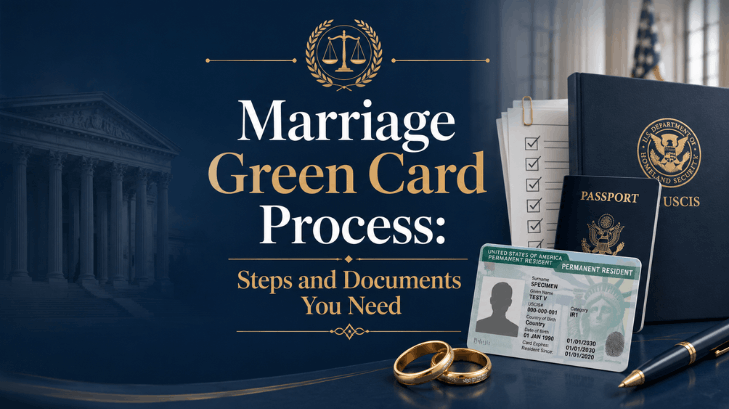
Marrying a U.S. citizen or green card holder does not automatically grant immigration status. Many couples are surprised to learn that the marriage green card process involves several forms, a medical exam, biometrics, and often an in-person interview before a foreign spouse can become a lawful permanent resident.
Understanding each stage in advance helps couples avoid common paperwork mistakes, missed deadlines, and processing delays. This guide walks through the marriage green card process step by step, the documents typically required, and what to expect along the way.
Every immigration case is different, and U.S. Citizenship and Immigration Services (USCIS) evaluates each application individually. This article explains the general process; it is not a substitute for advice from an immigration attorney or official USCIS guidance.
Quick Answer: How the Marriage Green Card Process Works
Getting a green card through marriage generally starts with the U.S. spouse filing Form I-130 to establish the relationship. If the foreign spouse is already in the United States and the U.S. spouse is a citizen, Form I-485 can often be filed at the same time. If the foreign spouse lives abroad, the case moves to the National Visa Center for consular processing instead. Along the way, applicants typically complete a medical exam, biometrics appointment, and an interview before a decision is made.
Quick Summary
- The marriage must be legally valid and entered into in good faith, not solely to obtain immigration benefits.
- Form I-130 is the foundation of every marriage-based case, whether the spouse is a U.S. citizen or a green card holder.
- U.S. citizens petitioning a spouse already in the U.S. can often file Form I-130 and Form I-485 together, which may shorten the timeline.
- Green card holders petitioning a spouse must wait for a visa number to become available under the F2A category, which can take longer.
- Couples married less than two years at approval typically receive a 2-year conditional green card and must later file Form I-751 to remove conditions.
- Processing times vary widely by USCIS field office, case complexity, and whether a Request for Evidence is issued.
Who Is Affected by the Marriage Green Card Process
This process applies to two main situations: a foreign spouse already living in the United States who wants to adjust status without leaving, and a foreign spouse living outside the United States who must go through a U.S. embassy or consulate abroad. The sponsoring spouse’s immigration status, U.S. citizen or lawful permanent resident, also changes how the case proceeds and how long it may take.
Real-World Scenario
Consider a couple where one spouse is a U.S. citizen and the other entered the country on a valid visa and later married. Because the foreign spouse is in the U.S. and the petitioner is a citizen, they may be able to file the I-130 petition and the I-485 adjustment application as one combined package, sometimes called concurrent filing. A different couple, where the U.S. spouse is a green card holder rather than a citizen, generally faces a longer wait because the foreign spouse falls into a numerically limited visa category and must wait for a visa number to become available before filing further paperwork.
Step-by-Step: The Marriage Green Card Process
Step 1: File Form I-130, Petition for Alien Relative
The U.S. citizen or green card holder spouse files Form I-130 with USCIS to establish that a valid marriage exists. This filing typically includes a certified marriage certificate and proof that any earlier marriages of either spouse were legally terminated.
Step 2: Determine the Path Forward
If the foreign spouse is living in the United States and a visa is immediately available, the next step is usually adjustment of status using Form I-485. If the foreign spouse lives outside the United States, the case is instead forwarded to the National Visa Center for consular processing, which uses Form DS-260 and an interview at a U.S. embassy or consulate.
Step 3: Complete the Medical Examination
A USCIS-designated civil surgeon (or a panel physician abroad) performs the required medical exam and documents results on Form I-693. Current USCIS filing rules generally call for this sealed exam to be included with the initial application package rather than brought separately to the interview, so it is worth confirming current form instructions before filing.
Step 4: Attend the Biometrics Appointment
USCIS schedules a biometrics appointment at a local Application Support Center to collect fingerprints, a photograph, and a signature, which support background and identity checks.
Step 5: Gather and Submit Evidence of a Bona Fide Marriage
USCIS closely reviews whether a marriage is genuine. Strong applications usually include a mix of financial, residential, and personal evidence showing the couple shares a life together, not just a legal marriage certificate.
Step 6: Attend the Green Card Interview
Most marriage-based cases include an in-person interview where both spouses answer questions about their relationship and the officer reviews submitted documents. Some straightforward, well-documented cases for couples already living together may occasionally be approved without an interview, though this varies by field office.
Step 7: Receive a Decision
If approved and the couple has been married two years or longer at approval, the foreign spouse generally receives a 10-year green card. If married less than two years, USCIS typically issues a 2-year conditional green card instead.
Step 8: Remove Conditions, If Applicable
Couples with a conditional green card must jointly file Form I-751 within the 90 days before the card expires to remove conditions and receive a permanent 10-year card. Missing this window can put the foreign spouse’s status at risk, so calendaring this deadline early matters.
Marriage Green Card Process: Forms at a Glance
| Stage | Key Forms | What It Covers |
| Petition for relationship | Form I-130 (and I-130A for spouse) | Proves the marriage exists and is legally valid |
| Adjustment of status (if spouse is in the U.S.) | Form I-485 | Applies to change status to permanent resident |
| Consular processing (if spouse is abroad) | Form DS-260 | Immigrant visa application through the National Visa Center |
| Medical exam | Form I-693 | Documents vaccinations and health screening results |
| Optional interim benefits | Form I-765 (work permit), Form I-131 (travel permit) | Lets the applicant work or travel while the case is pending |
| Removing conditions (if married under 2 years) | Form I-751 | Converts a 2-year conditional card into a 10-year green card |
Evidence and Document Checklist
Document requirements vary by case, but applicants are commonly asked to provide the following categories of evidence.
| Document Category | Examples |
| Identity and status documents | Birth certificate, passport, proof of the U.S. spouse’s citizenship or green card status |
| Marriage documents | Certified marriage certificate, divorce decrees or death certificates for any prior marriages |
| Bona fide marriage evidence | Joint bank statements, joint lease or mortgage, joint tax returns, shared insurance policies |
| Photos and communication records | Wedding photos, photos together over time, travel records, messages spanning the relationship |
| Medical and biometric records | Sealed Form I-693 from a civil surgeon, biometrics appointment confirmation |
| Financial sponsorship documents | Affidavit of Support (Form I-864), recent tax returns, proof of income |
Timelines: What to Expect
Processing times for the marriage green card process vary significantly depending on the USCIS field office, application volume, whether the sponsoring spouse is a citizen or green card holder, and whether a Request for Evidence (RFE) is issued.
Cases where a U.S. citizen sponsors a spouse already living in the U.S. and files concurrently tend to move faster than cases involving a green card holder sponsor, since the latter must wait for a visa number to become current under the F2A category before the foreign spouse can take the next step. For current, case-specific processing time ranges, USCIS publishes estimated times by form and field office on its website.
Mistakes to Avoid
- Submitting outdated form editions instead of the version currently listed on the USCIS website.
- Leaving required fields blank, which can result in the entire package being rejected.
- Failing to include certified translations for documents not originally in English.
- Sending one combined payment when separate fees are required for different forms.
- Missing the 90-day filing window for Form I-751 when removing conditions on a green card.
- Submitting limited evidence of a shared life together, which can trigger a Request for Evidence or longer scrutiny.
When to Speak With an Immigration Attorney
Couples with straightforward cases sometimes complete this process without legal representation, but certain situations benefit from professional guidance. These include prior immigration violations, a criminal history for either spouse, a previous visa denial, a prior marriage that ended unusually, or any uncertainty about eligibility. An immigration attorney can also help respond to a Request for Evidence or a Notice of Intent to Deny.
Practical Next Steps
- Confirm which path applies: adjustment of status (in the U.S.) or consular processing (abroad).
- Download the current form editions directly from USCIS.gov before filing.
- Schedule the medical exam with a USCIS-designated civil surgeon early in the process.
- Organize bona fide marriage evidence by category before assembling the filing package.
- Track the I-751 deadline immediately if a conditional green card is issued.
Get the Marriage Green Card Process Right From the Start
The marriage green card process involves multiple forms, evidence requirements, and waiting periods that depend on the sponsoring spouse’s status and where the foreign spouse currently lives. Filing complete, well-documented paperwork from the beginning is one of the most effective ways to avoid delays.
Because every case is different and immigration rules can change, readers exploring a green card through marriage should review current instructions on USCIS.gov and consider consulting a licensed immigration attorney before filing, especially if their situation involves prior immigration violations, a criminal record, or a complicated marital history.
People Also Ask
How long does the marriage green card process take?
Timelines vary widely. Cases involving a U.S. citizen sponsor and a spouse already in the U.S. who files concurrently are often resolved faster than cases involving a green card holder sponsor, which can take considerably longer due to visa number limits. Check USCIS.gov for current estimated processing times by office.
Can I work while my marriage green card application is pending?
A foreign spouse who files Form I-765 along with the adjustment of status application may receive employment authorization while the green card case is pending, though approval is not guaranteed and timing varies by case.
Do green card holders sponsor spouses the same way as citizens?
Not exactly. A U.S. citizen’s spouse is treated as an immediate relative with no annual visa cap. A green card holder’s spouse falls under the F2A preference category, which has limited annual visas and can mean a longer wait before the next steps are available.
What happens if USCIS doubts the marriage is genuine?
USCIS may issue a Request for Evidence asking for more proof, or schedule additional interview questions. In some cases, couples may be interviewed separately. Providing thorough, organized evidence from the start helps reduce this risk.
Do I need a lawyer for a marriage green card?
It is not legally required, but cases involving prior immigration issues, criminal history, or unusual circumstances often benefit from attorney guidance to avoid mistakes that could delay or jeopardize the case.
Frequently Asked Questions
Is a green card through marriage automatic once you get married?
No. Marriage alone does not grant immigration status. The foreign spouse must still go through the formal application process, including USCIS review and approval, regardless of how long the couple has been married.
What is the difference between adjustment of status and consular processing?
Adjustment of status applies when the foreign spouse is already living in the United States and files Form I-485 to change status without leaving. Consular processing applies when the foreign spouse lives abroad and applies for an immigrant visa through a U.S. embassy or consulate instead.
Can same-sex married couples use the same marriage green card process?
Yes. Federal immigration law recognizes legally valid same-sex marriages the same way as opposite-sex marriages for green card purposes, provided the marriage is legally valid in the place where it occurred.
What if my spouse and I divorce while the green card case is pending?
A divorce before the case is approved generally affects eligibility, since the marriage-based petition depends on an existing, valid marriage. Specific outcomes depend on the stage of the case, so speaking with an immigration attorney promptly is important.
Does filing fees information change often?
Yes, USCIS filing fees and form editions are updated periodically. Always confirm current fees and the latest form versions directly on USCIS.gov before submitting any application.
Legal Disclaimer
This article is for general informational purposes only and does not provide legal advice. Laws and procedures may vary by state, city, court, agency, or individual situation. For advice about your specific legal issue, speak with a qualified attorney or the appropriate government agency.