When parents separate or divorce, one of the first legal documents they will likely encounter is a parenting plan. For many parents, this raises immediate questions: What has to be in it? Does a judge have to approve it? What happens if the other parent will not cooperate?
A parenting plan is the written framework that tells both parents — and the court — how a child’s time, care, and major decisions will be handled after the parents no longer live together. Understanding how parenting plans work can make the separation process feel less overwhelming and help parents avoid common, costly mistakes.
This article explains what a parenting plan typically includes, how the approval process generally works, and what to expect if parents disagree. Because family law varies by state, readers should always confirm specific requirements with their local family court or a licensed attorney.
Quick Answer: How Does a Parenting Plan Work?
A parenting plan is a written agreement (or court order) that outlines how separated or divorcing parents will share parenting time, make decisions about their child, and communicate going forward. Parents can write a plan together, with a mediator, or have the court create one if they cannot agree. Once a judge signs off on it, the parenting plan becomes a legally enforceable court order that both parents must follow.
Quick Summary
- A parenting plan covers parenting time (the schedule), decision-making authority, and how parents will communicate about the child.
- Many states require a parenting plan in any case involving custody, whether parents agree or not.
- If parents cannot agree, each parent may submit a proposed plan, and the judge decides based on the child’s best interests.
- Once approved by the court, a parenting plan is enforceable, and violating it can lead to a contempt finding.
- Parenting plans can usually be modified later if circumstances change significantly.
- Requirements and forms vary by state, so always check local family court rules.
What Is a Parenting Plan?
A parenting plan is a written document that lays out how parents will raise their child after a separation, divorce, or other custody case. It typically addresses where the child will live and on what schedule, how parents will make major decisions, and how they will communicate and resolve disagreements going forward.
Many state courts require a parenting plan to be filed in any case involving custody or parenting time of a minor child — even when the parents already agree on the arrangement. Courts in states such as Florida, Washington, Maryland, and Utah use standardized parenting plan forms, while other states allow more flexible, attorney-drafted agreements.
A parenting plan is closely connected to broader custody decisions. If you are unfamiliar with how judges evaluate custody arrangements before a plan is even drafted, it may help to first read our related explainer on how child custody decisions are made, which covers the factors courts weigh, such as the child’s safety, stability, and relationship with each parent.
Who Needs a Parenting Plan?
A parenting plan generally applies to any parents who are separating, divorcing, or otherwise establishing custody and who will be raising a child while living apart. This can include:
- Married parents going through a divorce with minor children
- Unmarried parents establishing custody and parenting time for the first time
- Parents modifying an existing custody order due to a major change in circumstances
- Parents relocating, remarrying, or experiencing a change in work schedule that affects parenting time
Whether the parents are amicable or in significant conflict, most family courts expect a parenting plan to be part of the case file before a custody order can be finalized.
What Does a Parenting Plan Typically Include?
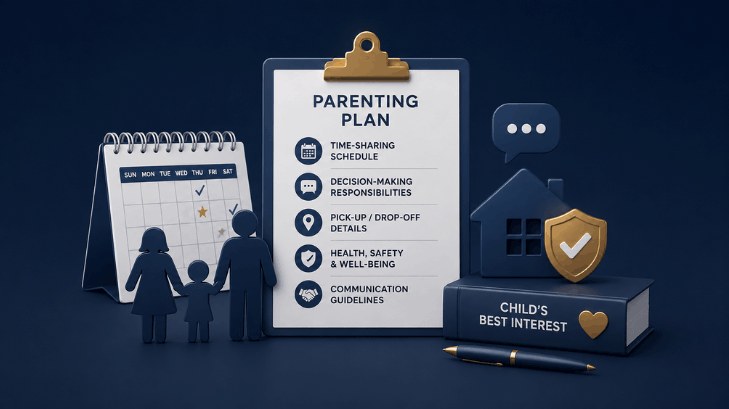
While requirements vary by state, most parenting plans address the same core categories:
1. Parenting Time (Custody Schedule)
This section lays out where the child will live on a day-to-day basis, including weekday and weekend schedules, holidays, school breaks, birthdays, and vacations. It often distinguishes between the regular schedule and special occasions.
2. Decision-Making Authority (Legal Custody)
This addresses who has the authority to make major decisions about the child’s education, healthcare, religious upbringing, and extracurricular activities. Parents may share this responsibility jointly, or one parent may have primary decision-making authority depending on the case.
3. Communication Methods
Many plans specify how parents will communicate about the child — for example, through a co-parenting app, email, or phone calls — and how quickly each parent should respond to messages involving the child’s well-being.
4. Dispute Resolution
Plans often include a method for resolving disagreements before returning to court, such as mediation, counseling, or a parenting coordinator. Courts may penalize a parent who uses these processes in bad faith.
5. Special Provisions
Depending on the family’s situation, a plan may also need to address relocation notice requirements, military deployment provisions, supervised visitation, substance-use or safety concerns, or transportation responsibilities for exchanges.
Importantly, in most states a parenting plan generally cannot override two basic principles: each parent typically retains the authority to make routine, day-to-day decisions while the child is in their care, and either parent may usually make emergency decisions necessary to protect the child’s immediate health or safety.
How the Parenting Plan Process Generally Works
While court procedures differ by state and by county, the general process tends to follow a similar pattern:
- Filing: The parent who starts the case (the petitioner) typically files a proposed parenting plan along with the initial custody or divorce paperwork. The responding parent usually files their own proposed plan as well.
- Negotiation or mediation: Many courts encourage or require parents to attempt to agree on a plan through negotiation or mediation before a judge gets involved.
- Court review: If parents agree, the judge reviews the proposed plan to confirm it serves the child’s best interests before approving it.
- Hearing, if needed: If parents cannot agree, the court may hold a hearing where each parent presents their proposed plan and supporting evidence.
- Court order: Once approved or decided by the judge, the parenting plan becomes part of a binding court order that both parents are legally required to follow.
If you are unsure whether your situation calls for a negotiated agreement or a court hearing, it can help to understand the difference between a contested vs. uncontested divorce, since this distinction often shapes how quickly a parenting plan can be finalized.
What Happens If Parents Cannot Agree?
If parents are unable to reach an agreement, each parent may submit their own proposed parenting plan to the court. The judge will then evaluate both proposals — and may modify either one — based on the best interests of the child. Courts commonly consider factors such as:
- Each parent’s relationship and involvement with the child
- The child’s need for stability and continuity
- Each parent’s ability to cooperate and communicate about the child
- Any history of domestic violence, abuse, or substance misuse
- The child’s preference, where age-appropriate and permitted by state law
If a parent fails to submit a proposed plan at all, some courts may simply adopt the other parent’s plan by default. This is one reason family law self-help resources consistently advise submitting a plan even if the parents are in significant disagreement.
Documents and Information Often Needed
While exact requirements depend on the state and court, parents preparing a parenting plan commonly gather:
- Current contact and address information for both parents
- The child’s school, healthcare provider, and activity schedule
- Work schedules and travel commitments that may affect parenting time
- Any existing custody orders, protective orders, or prior agreements
- Notes on any safety concerns that may need to be addressed in the plan
How Long Does a Parenting Plan Take to Finalize?
Timelines vary widely depending on the state, whether the parents agree, and how busy the local court calendar is. An uncontested plan that both parents agree on may be approved relatively quickly once filed, sometimes without a hearing. A contested case — where parents disagree and a judge must decide — generally takes longer, particularly if mediation, evaluations, or a trial are required. Parents should ask their local family court clerk or attorney for a realistic timeline based on their jurisdiction.
Can a Parenting Plan Be Changed Later?
Yes, in most states a parenting plan can be modified after it is approved, but typically only if there has been a significant change in circumstances — such as a parent relocating, a change in the child’s needs, or safety concerns arising after the original order. Modifying a plan generally requires filing a formal request with the court; parents usually cannot simply agree informally to ignore the existing order without risking enforcement issues.
Mistakes to Avoid When Creating a Parenting Plan
- Failing to file a proposed plan, which may result in the court defaulting to the other parent’s version
- Being too vague about scheduling, which can lead to repeated disputes over holidays and exchanges
- Focusing on what feels fair to the parents rather than on the child’s best interests, which is the court’s primary standard
- Leaving out a dispute resolution process, leading to unnecessary return trips to court
- Ignoring state-specific requirements, such as mandatory relocation notice periods or military deployment provisions
- Assuming an informal verbal agreement is enforceable without being entered as a court order
Parenting Plan Element vs. What It Covers
| Plan Element | What It Generally Covers |
|---|---|
| Parenting time schedule | Day-to-day living arrangements, weekends, holidays, school breaks, and vacations |
| Decision-making authority | Education, healthcare, religious upbringing, and extracurricular decisions |
| Communication plan | How parents will exchange information about the child |
| Dispute resolution | Mediation, counseling, or a parenting coordinator before returning to court |
| Relocation provisions | Notice requirements if a parent wants to move with the child |
| Safety provisions | Supervised visitation or limitations if there are safety concerns |
State and Local Variations to Keep in Mind
Parenting plan rules differ significantly across the United States. For example, some states use mandatory standardized forms (such as Florida’s Supreme Court-approved Parenting Plan or Washington’s official parenting plan form), while others, like Maryland, provide a parenting plan tool and instructions but allow more customization. Some states also have specific statutory provisions for military parents, such as Utah’s separate Military Parenting Plan requirement for deployment-related issues.
Because these differences can affect filing requirements, deadlines, and required disclosures, parents should always check their state court’s family law self-help center or speak with a local attorney rather than relying on another state’s forms or rules.
When to Speak With a Family Law Attorney
While many parents successfully create a parenting plan on their own or through mediation, it is generally a good idea to consult a family law attorney when:
- There is a history of domestic violence, abuse, or substance misuse
- One parent wants to relocate out of state with the child
- The parents strongly disagree on the schedule or decision-making structure
- One parent is in the military or has an unusual work schedule
- There are concerns about the other parent following the plan once it is in place
An attorney can help ensure the plan complies with state law, protects the child’s best interests, and reduces the chance of future disputes.
Practical Next Steps
- Check your state and local family court’s self-help resources for required parenting plan forms.
- Gather key information about your child’s schedule, school, and healthcare needs.
- Try to discuss a workable schedule and decision-making structure with the other parent, or consider mediation.
- Draft and file a proposed parenting plan, even if you and the other parent have not fully agreed.
- Consult a family law attorney if your situation involves safety concerns, relocation, or significant disagreement.
The Final Thoughts
Understanding how parenting plans work can make a difficult transition feel more manageable. At its core, a parenting plan exists to give children stability by clearly defining parenting time, decision-making responsibilities, and communication expectations between parents — whether those terms are agreed upon or decided by a judge.
Because requirements, forms, and procedures vary from state to state, the most reliable next step is to check your local family court’s self-help resources or speak with a qualified family law attorney about your specific situation. Taking that step early can help you build a parenting plan that genuinely supports your child’s well-being.
People Also Ask
Is a parenting plan the same as a custody agreement?
They are closely related but not always identical terms. A parenting plan is usually the detailed document describing schedules, decision-making, and communication, while “custody agreement” or “custody order” may refer more broadly to the court’s overall ruling, which often incorporates the parenting plan.
Do both parents have to agree on the parenting plan?
No. While agreement is preferred and often faster, parents who cannot agree can each submit a proposed plan. The judge will then decide based on the child’s best interests, sometimes combining elements from both proposals.
What happens if a parent violates the parenting plan?
Once a parenting plan is approved by the court, it becomes an enforceable order. If a parent does not follow it, the other parent may be able to file a motion to enforce, and the court may find the violating parent in contempt, depending on the circumstances and state law.
Can unmarried parents create a parenting plan?
Yes. Parenting plans are not limited to divorcing couples. Unmarried parents who are establishing or modifying custody and parenting time can also create or be ordered to follow a parenting plan, depending on state procedures.
Does a parenting plan address child support?
Typically, no. Parenting plans usually focus on time-sharing, decision-making, and communication, while child support is calculated and ordered separately, often using a state-specific child support worksheet or formula.
Frequently Asked Questions
How do parenting plans work if parents live in different states?
When parents live in different states, jurisdiction is generally determined under the Uniform Child Custody Jurisdiction and Enforcement Act (UCCJEA), which most states have adopted. This can affect which state’s court has authority to create or modify the parenting plan. An attorney can help clarify jurisdiction in these situations.
Can a parenting plan be changed without going back to court?
Informally adjusting a schedule for convenience may be common in practice, but it is generally not legally binding unless the court has approved a formal modification. To make lasting changes enforceable, parents typically need to file a request with the court.
What is the difference between physical and legal custody in a parenting plan?
Physical custody generally refers to where the child lives and the day-to-day parenting time schedule, while legal custody refers to the authority to make major decisions about the child’s upbringing. A parenting plan usually addresses both.
Do courts always follow the parenting plan parents submit?
Not necessarily. Even if both parents agree on a proposed plan, the judge must still find that it serves the child’s best interests before approving it. The court can request changes or, in rare cases, reject a proposed plan.
Is mediation required before creating a parenting plan?
This depends on the state and sometimes the specific county or court. Some jurisdictions require mediation attempts before a contested custody hearing, while others make it optional. Check local family court rules for specifics.
How often should a parenting plan be reviewed?
There is no universal rule, but many family law resources suggest reviewing a parenting plan periodically, especially in the early years after separation, since a child’s needs and schedules often change as they grow older.
Legal Disclaimer
This article is for general informational purposes only and does not provide legal advice. Laws and procedures may vary by state, city, court, agency, or individual situation. For advice about your specific legal issue, speak with a qualified attorney or the appropriate government agency.